2026 COLLEGE BASKETBALL:
DG’s “Fun Facts & Shout-Outs” Explore
ACC Basketball, Nine Foreign Countries
(Weekly Video = Posted Below)
By David Glenn
North Carolina Sports Network
(last updated Jan. 31, 2026)
While the focus of our “Time-Out” college basketball show is forward-looking as often as possible, we always take a glance back at the previous week’s action, too, and sometimes we’ll offer some quick mentions to those making impactful headlines on the hardcourt, especially in the National Basketball Association, Atlantic Coast Conference and/or across North Carolina.
With that in mind, below is this week’s edition of “Fun Facts and Shout-Outs,” brought to you by our good friends at Jimmy’s bar and King Neptune restaurant in Wrightsville Beach.
Jimmy’s has a full bar, nightly drink specials and live music 365 days a year(!). (It’s a great place to watch a game, too.) Right next door, King Neptune has become one of the best restaurants in the entire greater Wilmington area.

“Fun Fact #1″
Fun Fact: Entering the final day of January, among the top nine teams in the ACC standings, eight had a recent international signee in its regular playing rotation.
That’s a direct reflection of some brand-new NCAA rules that are in effect during this ongoing 2026 season for the first time in the history of the sport.
Here’s one intelligent way to look at it. There have always been four main sources of talent for college basketball programs: 1-high school prospects, 2-junior college products, 3-major college transfers and 4-international players.

In recent years, those last two categories — major college transfers and international players — have become much more important, largely because of NCAA rule changes.
Everyone knows about this new world for transfers. For more than a half-century, whenever a player jumped from one college program to another, the NCAA rules in place at the time dictated that he had to sit out an entire season at his new school. (He was allowed to practice with his new team, and he had to fulfill his academic obligations like any other player at his new school, but he was not allowed to compete in games that year.) Obviously, that served as a massive deterrent to transfers for about 50 years, and while there were plenty of transfers under those old rules, the numbers were tiny compared to those of today, now that virtually every transfer is immediately eligible at his new school.
A similar revolution is happening — right now — with that fourth and final college basketball talent pipeline: international players.

As with major college transfers, this is not a brand-new category, but — again — because of other brand-new NCAA rule changes, there has been an explosion in the number of international players on college basketball rosters, especially those who are coming directly to the college ranks from Europe or other parts of the world, rather than arriving in the USA as younger prospects to attend American high schools or prep schools.
Here are a few illustrations of those routes from yesteryear….
All the way back in 1980, the University of Houston signed a big man from Nigeria named Hakeem Olajuwon. There was so little precedent for that kind of thing back then — a player going from another continent directly to college hoops in the USA, with no American high school transcripts — that Olajuwon, who of course went on to become a college superstar for the Cougars and one of the greatest players in NBA history for the Houston Rockets, actually was forced to redshirt during his first season in college because of his complicated eligibility issues.
The overwhelming majority of the time, if you think of an international college basketball player from the 1980s, 1990s or early 2000s, that player typically spent a year or two playing high school basketball in the United States before becoming a college player here. That made college eligibility much easier.
For example, in the early 1990s, UNC had an All-ACC forward named Rick Fox. He was born in Canada and raised in the Bahamas, but he played high school basketball in the state of Indiana before beginning his career in Chapel Hill. That same sort of story later played out with a handful of other All-ACC players, including UNC center Serge Zwikker (Netherlands), Wake Forest forward Darius Songaila (Lithuania), Wake Forest forward Vytas Danelius (Lithuania), Duke forward Luol Deng (England), Maryland guard Greivis Vasquez (Venezuela), Florida State center Solomon Alabi (Nigeria) and Miami forward Kenny Kadji (France).
In each case, the international prospect spent at least one year at an American high school or prep school before matriculating in the ACC.

There are still stories like those for international players in college basketball right now, but what is increasingly common this year — for the first time in NCAA history — is the situation where a professional international player, often someone who is already 22 or 23 years old, comes directly from his European or other international pro club to an American college basketball roster.
That simply did not happen in the past.
The two main reasons for this explosion are the NCAA’s revised eligibility rules (which are complicated but now allow some players with previous professional experience to be eligible) and the NCAA’s brand-new rules that allow — for the first time in the 120-year history of the organization — universities to directly pay their own athletes in the form of what’s called revenue-sharing. Those new revenue-sharing rules are a byproduct of the recent legal case known as the House settlement.
Think about it. Unlike in the past, when maybe some international prospects either wanted the value of an American education or the challenge of major college basketball, now they can enjoy those things and receive revenue-sharing money from their university for the first time ever and receive third-party Name-Image-Likeness money on top of that, while also preparing for a career in what’s been traditionally viewed as professional basketball after college.
All of that explains the following list, going back to today’s Fun Fact. Among the top nine teams in the ACC standings, eight — every contender except Clemson — had at least one of these new-wave international players not only on their roster but in their playing rotation.
With that Fun Fact and this explanation in mind, it’s time for this week’s Shout-Outs, which are headed directly to those international players on those top ACC teams…

This Week’s Shout-Outs
#1—At Duke, shout-out to 19-year-old freshman forward Dame Sarr, a native of Italy and a projected first-round NBA draft pick who played the last three seasons for different teams in the system at FC Barcelona in Spain, which is one of the top professional clubs in all of Europe.
A 6-foot-8, 190-pounder on the wing, Sarr started 13 of the Blue Devils’ first 20 games while averaging about six points and three rebounds per game, hitting about 33 percent of his 3-pointers and seemingly embracing the role of defensive stopper, as he showed when he led the way in limiting star Stanford guard Ebuka Okorie (36 points against UNC) to just nine points against the Devils.
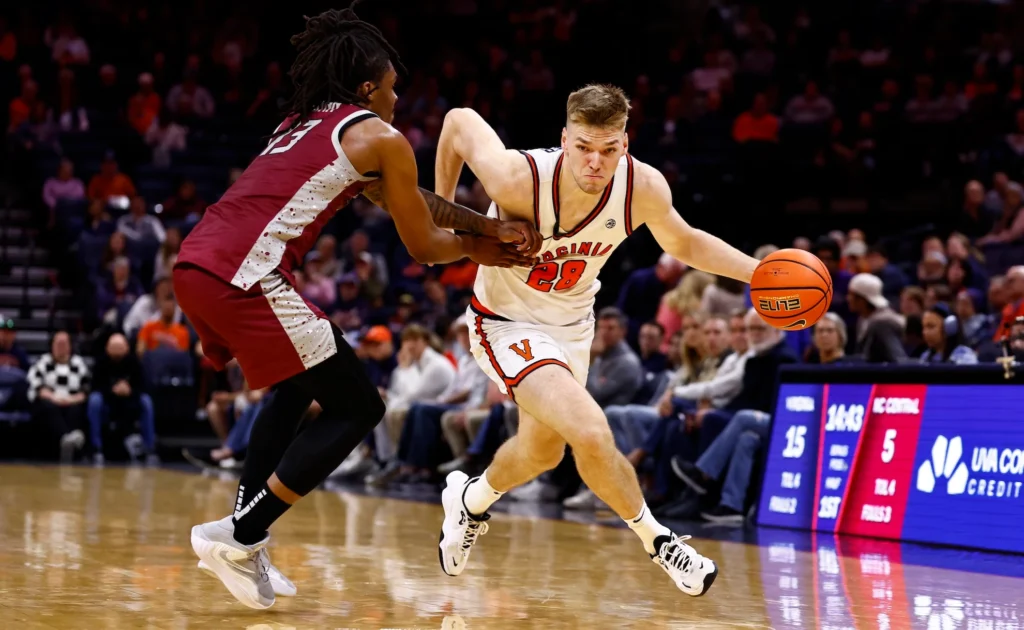
#2—At Virginia, shout-outs to the Cavaliers’ top two big men — 23-year-old freshman Thijs De Ridder, a 6-foot-9, 238-pound forward from Belgium, and 20-year-old freshman Johann Grunloh, a 7-foot, 238-pound center from Germany.
De Ridder, who is a very strong candidate for first-team All-ACC honors, played the last two seasons in Spain’s top league. Grunloh played the past two seasons in Germany’s top league. De Ridder is averaging a team-best 17 points per game and six rebounds per game while shooting 53 percent from the field and 37 percent from 3-point land. Grunloh leads the Wahoos in rebounding and ranks second in blocked shots.
#3—At Louisville, shout-out to 22-year-old German center Sananda Fru, a 6-foot-11, 250-pounder who played the past four seasons in his native country’s top pro league.
Listed as a junior for the Cardinals, he started the team’s first 20 games this season, averaging about 11 points per game, leading the team in rebounds and blocked shots, and shooting a sizzling 76 percent from the field.

#4—At North Carolina, shout-out to 22-year-old guard Luka Bogavac of Montenegro, who played the past two seasons in the Adriatic Basketball Association, which is another of the half-dozen or so best professional basketball leagues in Europe.
Bogavac started 13 of the Tar Heels’ first 20 games and ranks as their fourth-leading scorer, at about 10 points per game. A reputed sharpshooter overseas, Bogavac — who is listed as a junior by the Heels — has had some difficulty with the quickness and physicality of NCAA defenders, but he’s now shooting about 33 percent from 3-point land and 76 percent from the free throw line while also posting superb ball-handling numbers (51 assists, 19 turnovers) for a wing player.
#5—At NC State, shout-out to 23-year-old freshman Musa Sagnia, a 6-foot-10, 235-pound center from the west African nation of Gambia. He played the past four seasons for a professional club in Spain, including as a backup for the organization’s top-tier team.
For a while earlier this season, Sagnia led the Wolfpack in rebounding, despite playing entirely off the bench. He’s now shooting 68 percent from the field and ranks second on the team in blocked shots.
#6—At Miami, shout-out to 21-year-old freshman Timo Malovec, a 6-foot-8, 214-pound forward from Slovakia who has quickly become the Hurricanes’ most effective 3-point shooter, usually coming off the bench.
Malovec, who played the past two seasons in the Adriatic League, has played the most minutes of UM’s second-team performers and is hitting better than 37 percent of his 3-point attempts.

#7—At SMU, shout-out to 21-year-old sophomore Samet Yigitoglu, a 7-foot-2, 270-pound center from Turkey now in his second season as the Mustangs’ starter in the post.
Yigitoglu, who played three seasons in his native country’s top professional league before joining SMU, has started every game this season. He plays about 30 minutes per game and averages about 11 points per game while shooting almost 60 percent from the field and leading the Mustangs in rebounding and blocked shots.
#8—Last but not least, shout-out to Virginia Tech freshman Neo Avdalas, a 6-foot-9, 215-pound guard (yes, guard, at 6-9) who — as with Sarr’s story at Duke — put off the NBA draft for at least one more year when he signed with the Hokies last summer, after two seasons of professional competition in the Greek Basketball League.
Avdalas, a native of Greece who’s about to turn 20 years old, quickly has become Tech’s #1 playmaker. He leads the Hokies with five assists per game and ranks second in scoring, at about 13 points per game.
Just to put an emphasis on this week’s unusual theme, those ACC shout-outs visited the nations of Belgium, Gambia, Germany, Greece, Italy, Montenegro, Slovakia, Spain and Turkey. Indeed, you might say that American college basketball has indeed welcomed in a brand-new world of sorts this season.
Those are this week’s Fun Facts and Shout-Outs. As always, thanks for joining us on the North Carolina Sports Network.