Long-Time Athletic Director Explains
By Mike Waddell
North Carolina Sports Network
(last updated March 25, 2026)
This is no longer an industry where a proud logo, a famous arena and a legendary coach’s shadow are enough to carry the day.
Modern college athletics is a performance business, a media business, a talent-acquisition business, a donor business, a branding business and increasingly a front-office business.
Duke is winning because it appears to understand all of that at once, and because it has built a structure that treats football and basketball success not as isolated outcomes but as institutional value.
That is the heart of this story.

Duke’s success in the sports that drive the most attention and the most money — the Blue Devils are the reigning Atlantic Coast Conference champions in football, men’s basketball and women’s hoops — is not just good for the trophy case.
It is good for the Duke brand, good for the athletic department’s financial engine, good for the ACC’s most valuable inventory, and good for the broader economic life of Durham and the Bold North State.
Duke is not merely winning games. Duke is converting wins into enterprise value.
Start with the obvious scoreboard truth.
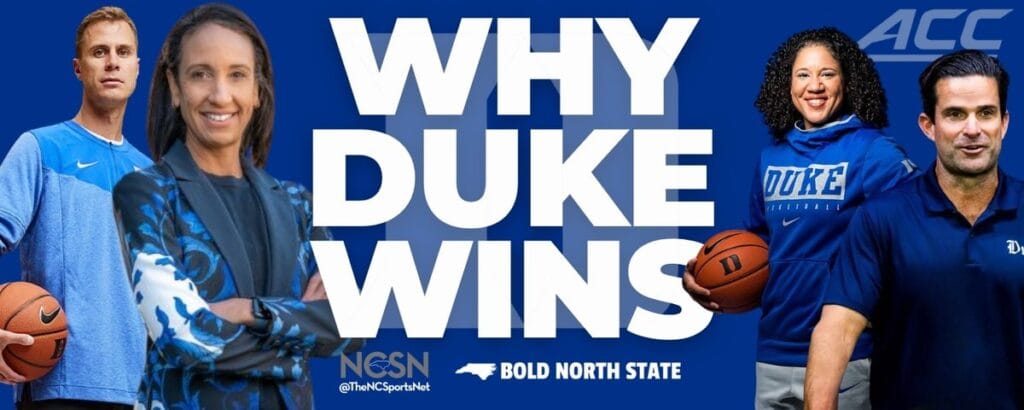
Duke just became the first school ever — in 73 years of ACC competition — to win the league’s football, men’s basketball and women’s basketball championships in the same academic year.

The Blue Devils now have two straight ACC titles, and three of the past four, under 38-year-old head coach Jon Scheyer.
In football, the Devils have four straight winning seasons, plus their first ACC championship since 1989 (first outright title since 1962), with the latter two campaigns led by 52-year-old coach Manny Diaz.
In women’s basketball, the Devils have two consecutive ACC crowns and four straight NCAA Tournament appearances, including trips to the Sweet 16 and Elite Eight, under 45-year-old coach Kara Lawson.
This combination is not merely a niche or trivial accomplishment. It’s a three-sport power statement in the exact sports that shape public profile, television relevance, donor excitement and institutional swagger.
And this is where the conversation gets more serious than it is about celebration. Duke’s own athletic economics make clear why this stuff truly matters.

The university’s 2023-24 athletic reporting, as summarized by The Chronicle (student newspaper), showed that Duke generated $166.9 million in athletic revenue, with more than 70 percent of that total coming from football and men’s basketball.
That means the sports drawing the most public attention also are the sports carrying the biggest share of the business load.
When Duke football and Duke men’s basketball rise together, the impact is not merely cosmetic. It also goes straight to the balance sheet.
Football, especially, has become central to the modern equation. The industry reality is that college media rights are driven overwhelmingly by football, with the vast majority of the value (some say 80 percent) typically attributed to football.
That is why Duke’s football breakthrough matters so much. Winning the ACC in football did not simply give Duke another banner. It gave Duke a more powerful fall product, more national relevance, stronger conference leverage, more donor energy and more year-round brand continuity.
Duke football is no longer just helping the story. It is helping drive the business.

The ACC benefits directly from this kind of Duke success.
The conference generated $711 million during the 2023-24 academic year and distributed a record average of $45 million to each of its 14 full-time member schools.
The largest sources of league value were the ESPN media deal, postseason football revenue and NCAA distributions, especially men’s basketball tournament money.
So when Duke is strong in football and men’s basketball, Duke is not merely helping itself. It is strengthening the league’s best inventory and adding value where the conference most needs it.
The local economy feels it, too.
Durham County’s 2024 visitor economy totaled $1.16 billion, generating more than $80 million in state and local tax revenue, according to local and state tourism reports.
No serious person should claim that Duke athletics alone created that entire figure. But no serious person should minimize the contributions of major Duke athletic events to that number, either.
Big-time Duke sports do not just fill seats. They help fill hotel rooms, restaurants, bars and the tax base.

March adds another layer of hard-dollar logic.
Each men’s NCAA Tournament “unit” is worth more than $2 million over six years, or almost $350,000 annually during that payout cycle. Conferences receive one unit for each Big Dance participant in a given year, plus additional units for each of those teams’ victories leading up to the championship game.
So a Duke run through March is not just a branding event or a recruiting billboard. It is conference currency. It has tangible value. It is another example of why elite men’s basketball remains so financially important to both the school and the league.
That is why the structure around the teams matters so much. Duke’s public-facing basketball operation is not built like a nostalgia exhibit. It is built like a modern sports enterprise.
Scheyer sits at the top as head coach. Still, the visible support structure around him includes associate and assistant coaches, player development personnel, additional staff (operations, video, creative, player branding, administration) and a general manager.
Rachel Baker was hired in 2022 into a newly created GM role specifically for Duke men’s basketball. David Bradley leads social media strategy, messaging, branding and recruiting support as creative director. Nick Colosimo is Duke’s associate director of player branding. Debbie Savarino (one of Mike Krzyzewski’s daughters) remains a major figure through the Legacy Fund, linking the current operation to the enduring Coach K architecture.
This is not accidental staffing. This is organizational design.

That organizational design is a competitive advantage because it creates efficiency and improves return on investment.
It lets the head coach coach. It lets branding people build the brand. It lets operations people handle operations. It lets player-facing staff develop players and support NIL-era realities.
In other words, Duke is not asking one person to be head coach, roster manager, fundraiser, public face, player-branding strategist and crisis coordinator all at once. Duke appears to have recognized that the modern game requires specialization, and specialization usually beats overload.
This is where a respect for the past meets a fierce focus on tomorrow.
Duke is not running from Coach K’s legacy. It is institutionalizing the useful parts of that legacy while modernizing the machinery around it.
That is a very different thing. It means Duke is not trapped in memory, and it is not trying to cosplay 2001 in a 2026 marketplace. It is trying to weaponize continuity. It is trying to take the premium expectations, donor culture and championship standard of the Coach K era and fit them into a newer operating model that includes front-office thinking, player branding, NIL navigation and a more professionalized support structure.
And that is why the bigger comparison matters.

Duke and Ohio State are the first athletic oligarchs of the Power Four era — the sports Rockefellers of the Power Four era, if you will, one private and one public.
In 2006-07, Ohio State became the first school in Big Ten history to win outright conference titles in football, men’s basketball and women’s basketball in the same school year. Duke has now done the ACC version of that in 2025-26.
A thorough review of the ACC, Big Ten, Big 12 and SEC championship histories suggests that those are the only two Power Four programs ever to reach that level of same-year, three-sport dominance across women’s basketball, men’s basketball and football.
That comparison is useful, because it sharpens what Duke has accomplished.
Ohio State did it in a far simpler era. Duke has done it as a private university in a much more complex and volatile environment. Same broad feat. Different marketplace. Different century. Different business model.
That is why this Duke moment deserves more than applause. It deserves recognition as proof of institutional adaptation.
Duke’s private-school status likely helps, too. Not because being a private institution guarantees better judgment, but because tighter discretion and stronger message control can matter in a world shaped by NIL strategy, donor alignment, rapid personnel movement and increasingly sophisticated program management.
Ohio State showed the public-school version of scale and power. Duke is showing the private-school version: tighter, quieter, premium-branded and highly coordinated. Different paths, same conclusion. Elite results are built on an elite structure.
And now you can see the whole picture. Duke’s is not just a story about stacking trophies. It is a story about university leadership aligning the three sports that matter most in the marketplace and turning that success into something bigger.
Football gives the university a fall flagship and strengthens the conference’s most valuable property. Men’s basketball remains one of the sport’s premier brands and a major financial driver. Women’s basketball adds another elite product, more visibility, more momentum and more competitive credibility across the entire department.
Together, they create something rare: a premium athletics brand operating near full power.
That is why Duke wins.
Duke wins because structure is strategy. Duke wins because alignment is strategy. Duke wins because return on investment is a strategy. Duke wins because it understands that in modern college sports, football and basketball success are not a side benefit; they are the engine.
And Duke wins because it has shown it can honor its past without getting stuck in it.
In the Bold North State and beyond, that is what real athletic power looks like.
Not just banners. Not just buzz. Not just branding.
Institutional value.
That is why Duke wins.
ABOUT THE AUTHOR: Mike Waddell is a former pro sports executive and Division One athletic director. He is now the CEO and co-founder of the North Carolina Sports Network.