And Who’s Next In Raleigh?
By David Glenn
North Carolina Sports Network
(last updated Oct. 27, 2026)
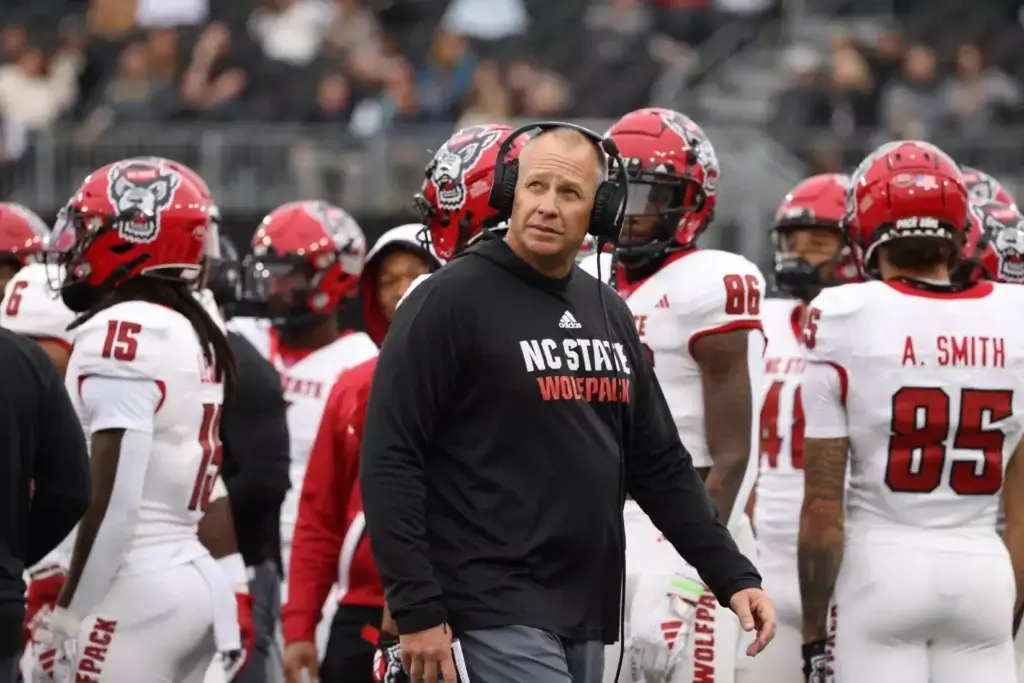
Here are some quick thoughts on NC State’s midseason dismissal of long-time head coach Dave Doeren, whose 14-year tenure with the Wolfpack had ranked as the fourth-longest active stretch in major college football, behind only those of Iowa’s Kirk Ferentz, Air Force’s Troy Calhoun and Clemson’s Dabo Swinney.

Former NC State athletic director Debbie Yow officially announced the hiring of Doeren on Dec. 1, 2012, as the successor to Tom O’Brien.
Doeren was about to turn 41 years old, and he was coming off two spectacular seasons as the head coach at Northern Illinois of the Mid-American Conference.
A former Wisconsin defensive coordinator, Doeren had posted a 23-4 overall record in his two seasons as the head coach at Northern Illinois, and his brief tenure there included back-to-back MAC championships, a stellar 15-1 conference record and a #16 national finish in the polls in his second/final season there.
During his lengthy tenure in Raleigh, Doeren did become the winningest coach in NC State football history, with 98 victories, and his 14-year tenure ultimately included 11 bowl invitations, four nine-win seasons and three Top 25 finishes (2017, 2021, 2023).
Under Doeren, NC State also typically ranked in the top third of the ACC in producing NFL draft picks, and the Pack sometimes ranked in the top four in the league in active NFL players, too. Doeren, his family and his players also immersed themselves in campus life and community service and, generally speaking, represented the university in a first-class manner.
At the same time, of course, Doeren’s average record with the Wolfpack over a decade-plus was roughly 7-5, he never reached the 10-win plateau or the ACC championship game, and he finished with a sub-.500 record in conference play.

With that very solid but very mixed resume in mind, and in fairness to Doeren, a brief history lesson is in order.
NC State has had 12 different full-time head football coaches since the Atlantic Coast Conference was created in 1953, and only three of them finished with both better overall records than Doeren’s 98-73 and better conference records than Doeren’s 52-57 mark.
Those three coaches were Lou Holtz and Bo Rein in the 1970s and Dick Sheridan from the late 1980s and early 1990s.
Arguably the greatest coach in program history, Holtz stayed for four years and led the Wolfpack to the ACC title in 1973, but he left after the 1975 season to take the New York Jets head coaching job in the NFL. Rein also stayed for four years and led the Pack to the ACC title in 1979 — that’s the program’s most recent ACC title, nearly five decades later — but Rein then left for the LSU job, although he died in a plane crash two months later and thus never coached a game with the Tigers. Sheridan stayed for seven years and took the Pack to six bowl games and three Top 25 finishes, but he retired after the 1992 season, at just 51 years old, citing health-related issues.
Anyone who wants to fairly judge Doeren’s 14-year tenure in Raleigh has to remember such things and the fact that, since the ACC went into expansion mode – first with Florida State in the early 1990s, and later with the likes of Louisville, Miami and Virginia Tech — Doeren had a slight advantage over Mike O’Cain, Chuck Amato and O’Brien in terms of his final winning percentages.
It’s also important to point out, for perspective, that all of the Wolfpack’s head coaches in this expansion era have ended their tenures with more losses than victories against ACC opponents. Doeren actually came closest to a .500 mark, with that 52-57 league record coming in at a success rate of almost 48 percent, and most Wolfpack fans would give him a lot of bonus points for beating UNC in eight of their last 10 head-to-head matchups, including the last five in a row.

Doeren, who will turn 55 years old in December, had said privately in recent years that he would not be one of those college football lifers who was still working as a head coach when he became a senior citizen, and maybe not even into his 60s at all.
The coach made more than $50 million in total compensation during his time at NC State, he has a roughly $10 million buyout coming his way because of the contract terms related to his dismissal, and he has spoken frequently about how much he enjoys hunting, fishing, playing golf and family time, in addition to the beach time, lake time and mountain time that became big off-the field parts of why he and his family enjoyed making North Carolina their home over these past 14 years.
Looking ahead, NC State chancellor Kevin Howell, athletic director Boo Corrigan and the other key Wolfpack stakeholders have three fundamental paths forward to consider as they contemplate Doeren’s successor.

Path #1—This is all about beloved Wolfpack alum Philip Rivers, who was the program’s star quarterback from 2000-03, before his two-decades-long career in the NFL. For most of the past six years, Rivers — the son of a high school football coach — has been the head football coach at St. Michael Catholic High School near Mobile in Alabama, which is Rivers’ home state.
Path #2—a sitting head coach. There already are plenty of Wolfpack fans talking about Wake Forest’s Jake Dickert or Duke’s Manny Diaz (who was on Amato’s staff at State in the early 2000s). There’s also Memphis’ Charles Huff, Cincinnati’s Scott Satterfield (a Triangle area native), Liberty’s Jamey Chadwell, Minnesota’s PJ Fleck, New Mexico’s Jason Eck, UNLV’s Dan Mullen (a former SEC head coach) and Western Michigan’s Lance Taylor, among many others.
Path #3—a prominent assistant coach. Among the names here are Florida Gators offensive coordinator Buster Faulkner (formerly of Georgia Tech), Indiana defensive coordinator Bryant Haines, Indiana offensive coordinator Mike Shanahan, Georgia defensive coordinator Glenn Schumann and Miami Hurricanes OC Shannon Dawson, among many others.
We’ll revisit all of those potential paths in/on our upcoming articles and shows here at the North Carolina Sports Network, but here are a few observations in the meantime.

First, everyone has had plenty of time to contemplate the Rivers possibility, so that would either happen fairly quickly behind the scenes or be off the table as a possibility very quickly.
Rivers has been a regular visitor to NC State over the years, he loves his alma mater, he understands and celebrates the program’s blue-collar culture, he knows football and has played it at the highest possible level, and he would raise the program’s profile and probably a lot of fundraising cash along the way.
About nine months ago, Rivers interviewed for the Buffalo Bills head coaching job in the NFL, but he withdrew his name from consideration just a few days later, after it had became clear that he would not get that job, mainly because of a coaching resume that’s limited to the high school level.
Would that same thin resume, or the extreme lack of historical examples of successful jumps directly from the high school coaching ranks into a head coaching position in a Power Four conference, scare off NC State?
At the same time, does Rivers, a 44-year-old father of 10 children — including his son Gunner, who’s the four-star Saint Michael quarterback and a Wolfpack football commitment, but also nine others, down to the age of two — really believe that the lifestyle of a college football head coach is the right fit for him at this stage of his life?
Second, with Dickert and Diaz in mind, a quick reminder that — while there’s no rule that prevents it — it’s extremely, extremely rare for a head coach to jump directly from one ACC program to another.
There have been only a few football examples (the most recent being Tom O’Brien leaving Boston College for NC State) over the past 70-plus years, and they all had various unusual circumstances in play.

In closing, some good news, some bad news and some big-picture perspective.
The broad perspective here is that many in the college sports world expect the next round of major conference realignment to come at or near the beginning of the 2030s, when a whole bunch of enormous college football TV contracts are scheduled to expire.
Obviously, like everyone else, NC State wants and needs its football program — the most valuable sport on campus — to be in a good place, so that the Wolfpack ends up in a desirable place (whether that’s the same-old ACC, a new-look ACC or a different league entirely) when that next series of dominoes fall into place.
The good news includes the fact that the NC State football job is viewed as a good one — not a great one, but a good one — because the sport has been an important priority for the administration and the school’s large, passionate fan base for a very long time. The Maryland job is open right now, but that’s widely viewed as a bottom-tier job in the Big Ten. The Baylor job is open right now, but that’s widely viewed as a bottom-tier job in the Big 12. The NC State job is not among the very best in the ACC, but it’s definitely not in the bottom tier, either.
Finally, as NC State continues to vet its potential targets and contemplates the future of Wolfpack athletics, it’s important to remember that many intrigued candidates may have some difficult questions.
For example, why is it that NC State hasn’t won a conference title in football since 1979? Why is it that no NC State football coach has been able to post even a career ACC record above .500 since Sheridan retired more than 30 years ago? Why is it that, prior to this disappointing final season under Doeren, superstar running back Hollywood Smothers left for Texas and star left tackle Jacarrius Peak left for South Carolina and talented young wide receivers Noah Rogers and Terrell Anderson left for Alabama and Southern Cal and starting linebacker Kenny Soares left for Michigan State?
Obviously, it’s extremely difficult to build something truly special if other Power Four programs are taking so many of your best players every year.
Doeren just was reminded of that fact the hard way, and it even contributed directly to him losing his job, so this is a very fair question that will continue to linger no matter who ultimately gets the NC State coaching job next.