Five Fun Facts Behind Hurricanes’
2026 Bid For Lord Stanley’s Cup
By David Glenn
North Carolina Sports Network
(last updated June 15, 2026)
Eight years ago, the Carolina Hurricanes were among the most downtrodden franchises in National Hockey League history.
Now the Canes are Stanley Cup champions.
One of the favorites eight months ago, at the beginning of the NHL’s 2025-26 regular season, Carolina defeated the Vegas Golden Knights 4-2 in the league’s best-of-seven championship series.
The Hurricanes’ 16-3 playoff record was the NHL’s best in the 40 seasons since the league adopted the modern format (requiring champions to win four consecutive best-of-seven series) in 1987.
With the Canes’ fascinating eight-year journey in mind, here are five pieces of background information worth considering as they continue to celebrate the second Stanley Cup championship in franchise history.

1. The Hurricanes already were responsible for the highest-level professional team championship in North Carolina history.
This is easy for some sports fans to forget, given that the NHL didn’t arrive in North Carolina until 1997, and the Hurricanes’ first Stanley Cup title came 20 years ago, in 2006, but at the highest levels of pro sports, what would possibly rank higher?
The Carolina Panthers, whose first National Football League season was in 1995, have never won the Super Bowl. The Charlotte Hornets, who began play in the National Basketball Association in 1988, have never even made the conference finals, much less challenged for an NBA title. North Carolina, of course, has never had a Major League Baseball team, although that may change at some point in the not-too-distant future.
With all due respect to the North Carolina Courage (2018 and 2019 champions of the National Women’s Soccer League), a handful of successful but defunct franchises such as the Charlotte Heat (1987 and 1988 champions of World Team Tennis!) and other top-level pro teams, and with a quick nod to the very real team aspect of NASCAR (whose racing teams are almost all based in North Carolina), the Hurricanes’ 2006 and 2026 Stanley Cup titles deserve top billing.
While the NHL ranks well behind the NFL, NBA and MLB in terms of popularity and revenue, it gradually has become the fifth-highest-revenue league in pro sports (at more than $7 billion annually), well behind the three above-mentioned American-based entities and only slightly behind the London-based Premier League, the highest-revenue soccer league in the world.

2. The Hurricanes are in the midst of the greatest extended run in their NHL history, which dates (pre-North Carolina relocation) to 1979.
Although exactly half of the NHL’s teams (16 of 32) make the playoffs in a given year, it’s not easy to make the postseason eight years in a row, as the Hurricanes now have done (2019 through 2026), and it’s not easy to win consistently once you get there.
League-wide, only the Colorado Avalanche (nine) and Tampa Bay Lightning (nine) have longer active postseason streaks.
The Hartford Whalers, while largely unsuccessful prior to their move to North Carolina, actually held the franchise record for consecutive playoff appearances for decades, thanks to their seven straight trips from 1986 through 1992. (They had missed the playoffs for the five straight years immediately before that streak and then missed the playoffs for the five straight years immediately after that streak.) However, the Whalers won only one of the eight postseason series they played from 1986-92.
The Hurricanes’ eight-year streak of postseason appearances has included 14 series victories and four trips to the Eastern Conference final. After falling short in the ECF in 2019, 2023 and 2025, they dominated this year’s “Final Four” series against Montreal, 4-1, extending their postseason record to a sparkling 12-1 against Ottawa, Philadelphia and the Canadiens before beating Vegas 4-2 in the final.

3. Everything changed in 2018, with new owner Tom Dundon, mostly for the better.
By the time long-time Whalers/Hurricanes owner Peter Karmanos sold his majority interest in the Hurricanes, in 2018, the Canes had become an embarrassment. Their attendance numbers ranked at or near the bottom of the league every year, and they missed the playoffs for nine consecutive seasons (2009-10 through 2017-18), one of the worst such streaks in NHL history.
Enter Tom Dundon, then only 46 years old, a self-made billionaire from Texas who had made his initial fortune in the subprime auto lending industry. At the time, he was not at all a “hockey guy” — didn’t play the sport, didn’t watch it much — and most of his family and friends didn’t even know there was an NHL team in North Carolina when he purchased the Hurricanes.
Now 54, Dundon plays the part of the eccentric billionaire well. He still lives with his wife and younger children (he has five) in Dallas; during his extended stretches in Raleigh, he often travels by private plane and lives out of high-end hotels. Nevertheless, his most frequent attire remains that of a college guy — Hurricanes pullover, Hurricanes baseball cap — and, for many years, he often hitched rides to meals and appointments because he didn’t have his own vehicle in Raleigh.
While Dundon has received criticism from many Hurricanes fans for some of his fiscal decisions, including rising ticket/concession/parking prices and the compensation-related departures of extremely popular broadcasters Chuck Kaiton and John Forslund, he has earned praise for his willingness to spend big money in other areas, including on highly productive young players.
After many seasons under Karmanos in which the Hurricanes didn’t spend close to the NHL salary cap, Dundon has shown repeatedly that he’s willing to spend big. In most years, the Hurricanes’ player payroll has matched or neared the league’s salary cap, which was $95.5 million this season.
“I don’t think in terms of an annual budget. I think in terms of value,” Dundon said. “Where we see value, we’ll pay for it.”
In the 2019 offseason, after the big-money Canadiens signed young Hurricanes star Sebastian Aho to a front-loaded five-year, $42.3 million offer sheet, essentially challenging the new Canes owner’s deep pockets, Dundon matched the offer and retained Aho within a week.

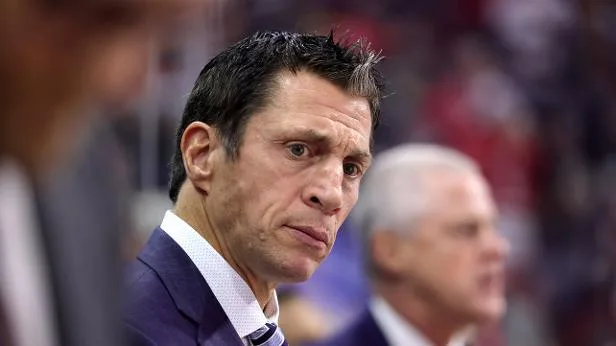
4. One of Dundon’s first decisions proved to be among his best: hiring head coach Rod Brind’Amour.
The owner-coach relationship between Dundon and Rod Brind’Amour, the Hurricanes’ eighth-year head coach, seems uncommon in professional sports.
Dundon openly describes Brind’Amour as one of the most impressive people and leaders he’s ever met, in any context, in his entire life. He says he has a hard time imagining doing anything as an owner, even beyond personnel decisions, if Brind’Amour were adamantly opposed to the idea. He says he believes that Brind’Amour, who’s been universally respected around the NHL since his playing days, is the #1 reason free agents consider the Canes during the offseason.
Dundon even has said publicly, and apparently genuinely, that he’s not sure he will want to own the Hurricanes whenever the day comes that Brind’Amour, 55, is no longer the coach.
“He’s definitely our most important person,” Dundon said. “You have to separate players from everyone else, obviously, but this wouldn’t have worked without Rod.”
For a long time, Brind’Amour, the Hurricanes’ gritty captain and legendary on-ice/off-ice leader when they won the Stanley Cup in 2006, wasn’t sure he wanted to be a full-time coach.
Within months of his retirement as a player, following the 2009-10 season, Brind’Amour married Amy Biedenbach, daughter of legendary UNC Asheville basketball coach (and former NC State assistant) Eddie Biedenbach. The following year, in 2011, the Brind’Amours had a son, Brooks. Rod Brind’Amour also has three children from a previous marriage.
Initially, in 2010, Brind’Amour took only a part-time coaching role with the Hurricanes, as he wanted to focus on being a family man, as a husband and father of four. By 2011, though, he was a full-time assistant, and in 2018 he got his chance as the head coach. He earned the NHL’s coach of the year honor in 2021 and has been among the leading vote-getters for that award several other times.
Asked about the starting point for the Hurricanes’ dramatic culture change, which enabled them to go directly from nine straight playoff misses to eight straight playoff appearances, Dundon used only four words.
“Hiring Rod,” Dundon said. “That’s it.”

5. This season was no Cinderella story, as the Hurricanes had the second-best record during the NHL’s six-month-long, 82-game regular season, which ended in mid-April.
Entering the 2026 postseason, the Hurricanes were truly proven commodities in almost every way.
During the regular season, only Colorado (55-16-11; 121 points) had a better record than the Hurricanes (53-22-7; 113 points). Similarly, only the Avalanche (302) scored more goals than the Canes (296), whose defense-first mindset, consistent discipline and tight neutral-zone coverage helped them prevent goals at an impressive rate, too.
Whereas Carolina’s recent playoff exits typically had come because its goal-scoring dried up against some combination of bigger/stronger opponents and red-hot netminders, the 2026 Hurricanes all along had reason to believe that they had enough offensive diversity to avoid a similar fate.
In fact, the Hurricanes had the most 20-goal scorers (seven) in the entire NHL during the regular season: center Seth Jarvis (32), right wing Andrei Svechnikov (31), Aho (27), left wing Nikolaj Ehlers (26), right wing Jackson Blake (22), center Logan Stankoven (21) and center Jordan Staal (20).
The team’s 296 goals during the regular season set the all-time franchise record, surpassing the 286 regular-season goals of the 2005-06 squad, which went on to capture the Stanley Cup.
During the team’s 16-3 postseason this year, 11 players had two or more goals: Stankoven (11), Ehlers (eight), Staal (eight), Blake (seven), forward Taylor Hall (seven), Svechnikov (six), Aho (five), Jarvis (four), defenseman Shayne Gostisbehere (three), forward Eric Robinson (three) and forward Jordan Martinook (two).
Overall, throughout the 2026 postseason, the Hurricanes always appeared to be at least as good as anyone else still skating.
That didn’t guarantee another Stanley Cup, of course, but it certainly underlined the Canes’ best chance since 2006 to reach the NHL’s mountaintop … and leave another unforgettable, everlasting mark on the North Carolina sports scene.

Stanley Cup Championship Series
(Best-Of-Seven Format)
Game 1: Golden Knights 5, Hurricanes 4
Game 2: Hurricanes 4, Golden Knights 3 (OT)
Game 3: Golden Knights 5, Hurricanes 4 (2OT)
Game 4: Hurricanes 5, Golden Knights 3
Game 5: Hurricanes 4, Golden Knights 2
Game 6: Hurricanes 3, Golden Knights 0