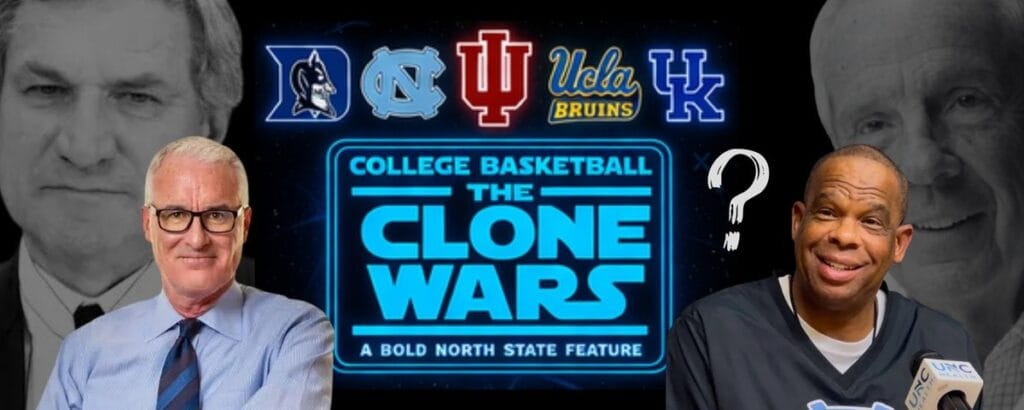
THE CLONE WARS:
Why Blue-Blood Programs
Keep Losing To Their Own Past
By Mike Waddell
North Carolina Sports Network
(last updated March 23, 2026)
Why has it been so difficult for college basketball legacy programs such as UCLA, Kentucky, North Carolina and Indiana to keep winning at that “program standard” from before the Name-Image-Likeness era?
You know, back when dinosaurs roamed the earth and there were only 32 channels on basic cable.
No, it’s not “THE FORCE”.
It’s people trying to #force translation of one way of doing things — in this case, running a college basketball program the same way, from way back in the day, and then trying to do the same thing the same way from the 1960s in a world that is not the same as it was 60 minutes ago.
It’s changing fast. Life. College sports. Everything.
And here in college basketball, these forever brands — these Bruins, Wildcats, Tar Heels and Hoosiers of the new dribbling 2020s — are finding it hard to consistently “live up” to what the all-knowing fans and media say is the “program standard”.

It is not entirely about money.
Let’s take a short walk on this subject. Indiana is spending $32 million on men’s basketball and has missed the NCAA Tournament eight times in ten years.
It is not entirely about tradition.
Only one program in America has more championship-level history than Kentucky, yet coach John Calipari spent his final five seasons in Lexington producing a combined two postseason wins.
It also is not entirely about facilities, fan bases, recruiting pipelines or conference affiliations.
All of those things are present at Indiana, Kentucky, UCLA and UNC. None of them has been sufficient.
The pattern is something simpler and more dangerous than any of those things. The pattern is that the most legacy-dependent programs in college basketball have spent the last decade at war with their own past — not honoring it intelligently, not releasing it strategically, but desperately cloning it.
They keep trying to reproduce an era that no longer exists, using the identity architecture of coaches who are retired or gone, in a marketplace that has structurally changed in ways those eras never anticipated.
Call it what it is.
This is The Clone War, and the blue bloods are losing it.
“Welcome Back My Friends …
To The Show That’s About To End”
In the actual Clone Wars series, an army of genetically identical soldiers was deployed to fight battles that the Republic’s original military was never designed to win.
The clones were efficient replicas, but they were not originals. They could execute orders, but they could not generate a strategy. And when the battlefield changed — as battlefields always do — the clone army was designed for yesterday’s war.
That is a useful metaphor for what Indiana, Kentucky, UCLA and — potentially — UNC have been doing with their coaching hires and their program identities for more than a decade.
The Clone War in college basketball works like this: a legendary coach — Bob Knight at Indiana, John Wooden at UCLA, Calipari during his peak at Kentucky, Dean Smith at UNC — defines a program so completely that the institution comes to believe the coach is the program.
The banners, the culture, the recruits, the donor base, the national identity — all of it becomes fused with a specific human being and a specific era.
Then that human being leaves. And the institution, consciously or not, spends years trying to replicate what it had rather than building what the current marketplace requires.
Sometimes, the clone is as close to literal as possible — the hiring of a former player of the legend, someone who bleeds the same blood, who sat in the same practices, who speaks the language of the founding era.
Indiana hired Mike Woodson, a Bob Knight player, in 2021. Kentucky hired Mark Pope, a former Kentucky player, in 2024. Within two seasons, a Kentucky basketball publication was noting that Pope’s team was “stuck between two identities,” playing a style that looked “more like a John Calipari team than a Pope team.”
UNC has run its coaching succession through Smith’s family tree from 1961 all the way until at least mid-2026.
Sometimes, the clone is merely stylistic — not a bloodline hire but a philosophy hire, an attempt to recreate the tempo, the culture, the recruiting approach of the golden era, without the originator who made it all work.
In every version, the outcome is the same. The clone is never the original. The battlefield is not the same one the original won on. And the program ends up stranded between what it was and what it needs to become.

Indiana: The Most Expensive
Clone Failure in College Hoops
Start with Indiana, because no program in college basketball tells this story more completely or more painfully.
Knight won three national championships at Indiana: in 1976, 1981 and 1987. He defined the program’s identity so absolutely — the discipline, the motion offense, the Assembly Hall atmosphere, the Big Ten bloodlust — that every coaching hire after his departure in 2000 has been measured against his ghost.
Mike Davis. Kelvin Sampson. Tom Crean. Archie Miller. And finally, in 2021, Woodson — Knight’s own former player, a man who played for Knight from 1976-80 and carried the bloodline directly.
The Indiana athletic department did not just hire a coach in 2021. It hired a symbol. It hired continuity. It hired the closest thing to a Knight clone that the program could ethically produce.
And it failed completely.
Woodson departed in February 2025, after four seasons in which Indiana missed the NCAA Tournament twice, finished 19-13 in his final year — left out of the field despite playing in the Big Ten — and produced no postseason hardware of any kind. During that same period, Indiana spent approximately $32 million on men’s basketball NIL and roster support, reportedly the highest figure in the country.
The program spent more than almost anyone else, hired a direct Knight bloodline coach, played in one of the most storied venues in the sport, competed in the financially soaring Big Ten … and missed the Big Dance eight times in 10 years.
Indiana then hired Darian DeVries in March 2025 — a 49-year-old head coach from West Virginia with no Indiana connection, no Big Ten history and no relationship to the Knight era.
DeVries is the anti-clone. He is the first Indiana head coach since Knight arrived in 1971 who walks into Bloomington without a single thread of the old fabric.
That hire tells you something important: Indiana finally blinked.
After more than two decades of trying to win with the Knight identity — or some variation of it — the program made the hire it needed rather than the hire it felt comfortable making.
Whether DeVries succeeds in the long run remains to be seen, but the decision to make the break is itself a form of institutional evolution.
Indiana may use its 2025-26 season as its first data point; the Hoosiers missed the NCAA field again, their ninth miss in 10 years.
The war is not over, but the clone has finally been retired.

Kentucky: The Calipari Clone,
An Identity Stuck in the Middle
Kentucky’s version of The Clone War is more nuanced, more recent and more instructive precisely because it is still in motion.
Calipari arrived in Lexington in 2009 and immediately turned the program into a one-and-done factory. He signed many of the top high school prospects in the country, winning a national championship in 2012, and produced a stunning run of high NBA draft picks.
Calipari was not cloning UK legend Adolph Rupp or anyone else. He was building something new. He was the original.
But somewhere around 2018, Calipari started cloning himself. The same recruiting approach. The same roster construction. The same one-and-done dependency. The same philosophical framework in a marketplace that had changed around him.
The portal opened. NIL arrived. The one-and-done pipeline became available to programs that previously could not compete for those players. And Calipari — instead of evolving — kept running the same system in a different war.
The results told the story. His final five years in Lexington produced a combined two postseason wins, including a first-round exit to #14 seed Oakland in 2024. He left for Arkansas before the 2024-25 season, and at Kentucky, Pope arrived.
Pope is a Kentucky man — a former Wildcat player, someone who understands the Rupp Arena energy and the Big Blue Nation expectations from the inside. In that sense, the hire carried a familiar bloodline quality.
But Pope is not trying to clone Calipari, and he is he trying to clone the Rupp era. He is trying to build something identifiably Kentucky in its values while being genuinely modern in its methods.
The problem, according to some of those watching closely, is that the transition is incomplete.
Kentucky basketball in 2025-26 was described as “stuck between two identities” — moments of the fluid, confident Pope system followed by possessions that looked exactly like Calipari’s late-career turbulence.
Pope’s short-term production already exceeds that of Calipari’s final five years — three tournament wins in two seasons versus Calipari’s two wins across the same timeline.
But the identity question at Kentucky is genuinely unresolved. Is Pope’s Kentucky the real Kentucky? Or is it a transitional stage before someone else defines the program for the next era?
That question does not have an answer yet. But it is the right question to be asking. And the fact that Kentucky is asking it — rather than simply hiring another Calipari and watching the same movie again — suggests the program may be closer to the evolution it needs than Indiana was when it hired Woodson.
UCLA: Fifty Years Later,
Still Looking for Wooden?
The Clone War at UCLA is the longest-running in the sport, and the most impossible by design, as no one has replaced the Wizard on top of his Pyramid in Westwood.
Wooden won 10 national championships at UCLA from 1964-75. Ten. In twelve years. No program in the history of the NCAA’s revenue sports has produced anything remotely comparable to that run, and perhaps no program ever will.
The standard Wooden set with the Bruins is not merely a difficult-to-reach one. It is an impossible standard. It is the sporting equivalent of asking someone to clone Shakespeare and then being surprised when the clone writes competent but not transcendent prose.
UCLA has hired eight head coaches since Wooden retired in 1975. Some were good. None was Wooden. The program made three Final Fours between 1975 and 2006, won no championships, and spent the next two decades cycling through coaches who arrived carrying the weight of the Pauley Pavilion mythology and left without having come close to satisfying it.
Mick Cronin arrived in 2019, moved to the Big Ten with the program in 2024, and has produced the most stable UCLA basketball in years — a Final Four in 2021, back-to-back Sweet 16 appearances in 2022 and 2023, and a return to the Round of 32 in 2025.
Cronin has 527 career wins. He runs a disciplined, well-organized program. Overall, though, he is emphatically not trying to clone Wooden.
And UCLA fans, by a measurable fraction, have remained unsatisfied.
That is the most honest summary of the Wooden Clone War: The program has been unsatisfiable for 50-plus years because it made the mistake of allowing one man’s impossible greatness to become the definition of institutional success. When the bar is 10 championships in twelve years, every other outcome — including legitimate Final Fours, Sweet 16s and a well-run department — is perceived as failure.
The clone those critics want simply does not exist. It never will. The question is whether UCLA can build a new identity that does not require Wooden’s ghost to validate it.
Cronin may be the coach who finally forces that conversation. He is functional, stable and unglamorous in comparison to the Wooden era. If the program moves past him, looking for the next Wooden, it will simply be choosing another decade of the same war. If it commits to building on what Cronin has constructed in the Big Ten, it might finally start winning the war by changing the terms of it.

UNC: The Clone War That’s
Still Brewing In Chapel Hill
Carolina’s Clone War has not fully started yet. It is about to.
For 65 years, the lineage from Smith to Bill Guthridge to Matt Doherty to Roy Williams to Hubert Davis has kept the program inside the family Smith built.
That was not an accident or a sentiment. It was a deliberate institutional choice — a belief that the Carolina Way, the Carolina culture, the Carolina standard is most faithfully maintained by those who learned it from the inside.
Doherty and Davis played for Smith. Guthridge and Williams coached under Smith. The chain has been intact since 1961.
If Davis is not retained — at this writing, that decision appears imminent — UNC likely will hire its first men’s basketball head coach in the modern era with no playing or coaching connection to Smith or Williams.
That is not simply a staffing event. It is the beginning of a fundamental identity question: Is UNC basketball a program defined by its Smith-Williams lineage? Or is it a program defined by its values, its standard, its competitive ambition — regardless of who carries those things forward?
UNC third-year chancellor, Lee Roberts, has the aura of an athletics oligarch, a political animal. Many inside and beyond the “Carolina Family” believe his #1 goal is for his own name, image and likeness to be projected forward in a high-profile manner.
If Roberts sees a political advantage, whether now or down the road, that likely will play a big part in his appreciation (or not) for traditions, if not an unspoken code which had been the “force” which guided things in Chapel Hill, dating back to Yoda Dean Smith and up to Obi-Wan Roy Williams.
Sadly for the Tar Heels, their Luke Skywalker has not yet presented himself, or perhaps he has been in place and simply not supported in the right way by a laissez-faire administration.
The wrong answer to that question produces the Indiana outcome: a desperate search for the most Smith-adjacent candidate available, a hire designed to preserve the bloodline at the expense of choosing the best possible modern operator, a program that spends the next decade trying to clone an era it cannot reproduce in a marketplace the original did not have to navigate.
The right answer — the Duke-with-Jon-Scheyer answer — is to clearly define what is non-negotiable about the program’s identity, and then find the best possible person to honor those non-negotiables while building a modern operation around them.
Not the most familiar person. Not the most Smith-adjacent person. The best person for 2026 and beyond.
That distinction sounds simple. It is not. The emotional pull of legacy hires is enormous at programs such as UNC. The donor base expects continuity. The former players expect the family to stay intact. The mythology demands someone who speaks the language fluently.
But Indiana spoke the language fluently with Woodson, spent $32 million and missed the tournament eight times.
Speaking the language is not the same as winning the war.

The Duke Exception
Duke is not immune to this pressure. It simply managed it better than anyone else.
Scheyer played for Coach K. He served as an assistant under Coach K. He learned the Duke language from the source. In that sense, the hire carried obvious continuity value.
But what separated Duke’s approach from Indiana’s hire of Woodson — which carried the same surface-level logic — was the architecture built around the coach.
The GM. The player branding director. The creative director. The recruiting infrastructure. The Blue Devils’ modern roster-construction philosophy is built around skill, wingspan, offense/defense balance, elite high school recruiting and a scalpel-like portal strategy.
Scheyer was not hired to be Coach K. He was hired to honor what Coach K built while running something new.
The back-to-back #1 recruiting classes in 2024 and 2025 were the output of that architecture. The back-to-back ACC Tournament titles were the output of that architecture. The three-sport convergence in 2025-26 — championships in football, men’s basketball and women’s basketball in the same academic year — was the output of that architecture.
Duke did not clone Coach K. Duke weaponized his legacy while rebuilding the machinery underneath it. That is the difference between honoring the past and being imprisoned by it.
The End Of The Clone War
College Basketball’s Clone War is not over.
It cannot end until programs accept a truth that runs directly against their institutional instincts: “Legacy is a recruiting tool. It is not a strategy.”
The banners attract players. The name recognition opens doors. The mythology creates donor energy, fan engagement and national media attention. None of that is nothing. All of it matters.
But none of it wins in March. None of it navigates the transfer portal. None of it builds a $14 million NIL roster. None of it creates the front-office depth that lets a head coach coach rather than manage 15 simultaneous crises alone.
Indiana has plenty of banners. It also missed the tournament eight times in 10 years.
Kentucky had Calipari. It then produced two postseason wins in five years.
UCLA has Wooden’s name on the building. It has not been elite since 1975.
UNC has the Smith Center (in some form), the powder blue and six NCAA titles, one (2017) less than a decade ago. It also has back-to-back Round of 64 exits and a lust to live out the lyrics to a McCartney Classic… “Yesterday, all my troubles seemed so far away, oh I believe in Yesterday.”
The programs that are winning in the modern era are the ones that have figured out how to carry their history as fuel rather than as weight.
Duke is the clearest example. UConn under Dan Hurley — who has no UConn bloodline but built something entirely new — is another. Kansas, with Bill Self constructing a genuinely modern operation inside a traditional framework, is a third.
In every case, the formula is the same. Define what is actually non-negotiable. Build the modern machinery around it. Hire the person best suited to run both. And resist — with institutional discipline — the emotional gravity of the familiar clone.
The bluebloods who figure this out will compete for championships in the 2030s.
The ones that keep cloning will keep fighting a war they designed for 1986 in a marketplace that is already in 2026.
In the Bold North State and beyond — in Chapel Hill, Bloomington, Lexington and Westwood — that is the real strategic choice sitting on every athletic director’s desk right now.
Not whom to hire. Not how much to spend. Not what to build.
Whether to finally stop cloning — and start evolving.
That is The Clone War.
And the only way to win it is to end it.