College Basketball In 2026:
Smarter AI Approach Necessary
To Build Better Basketball Teams
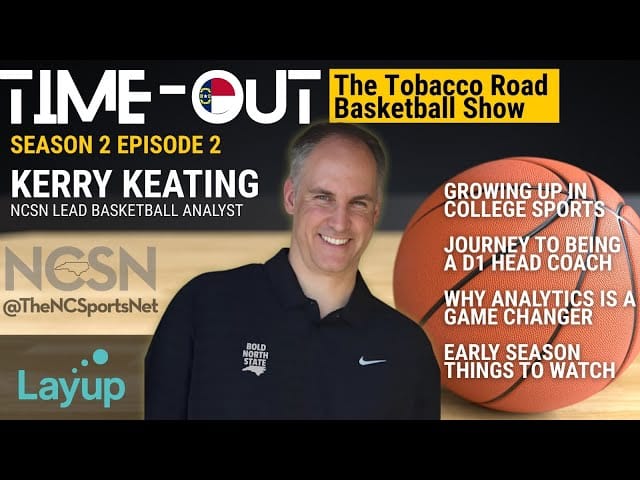
By Kerry Keating
North Carolina Sports Network
(last updated April 20, 2026)
I have spent 30 years finding edges before anyone else knew they existed. Digital video before staffs believed in it. Cloud infrastructure before programs knew they needed it. Recruiting intelligence before CRM software existed for athletics.
Every time, the pattern was the same: The first adopters looked a little crazy, then they looked smart, then everyone else was catching up and calling it evolution.
The argument Noah Henderson has been making through The College Front Office is right: The Name-Image-Likeness (NIL) and portal era has professionalized the game, whether programs are ready for it or not, and the institutions still running roster construction on relationships and instinct are going to lose to those that have built systems. Early always feels like overkill, and then it becomes the floor everyone else builds from.

That is why I built Layup. The clearest way I can explain why it matters right now is through an unexpected lens: What the world’s largest enterprises are currently figuring out about artificial intelligence (AI) implementation maps almost exactly onto what college basketball programs are about to go through. That pattern is about to repeat itself faster than anything I have seen before.
Aaron Levie, the CEO of Box, posted a thread recently after spending time with information technology (IT) and AI leaders across banking, media, retail, healthcare, consulting, tech and sports. His takeaways were about how large enterprises are actually implementing AI — not in demos or press releases, but in the infrastructure that changes how decisions get made every day.
Almost every observation he made about the enterprise world maps directly onto what college programs are about to go through. The programs that recognize that parallel now, before it becomes obvious to most others, are going to have a meaningful head start.

Moving AI From Chat To Agents
The first thing Levie noted from his conversations was that the enterprise world is moving from the chat era of AI to the agents era.
Chat is what most people think of when they think of AI right now. You ask a question, you get an answer. It’s useful and it’s fast, but it doesn’t do anything. It’s a very expensive search engine with better syntax.
Agents are different. Agents use tools. They process data. They perform real work within a workflow without needing to be prompted at every step.
The implication for college basketball is direct. The programs still asking an AI chatbot to write recruiting messages or summarize a stat line are in the chat era. The programs building evaluation infrastructure that processes portal data, surfaces fit signals and delivers a ranked, contextualized shortlist before a coach ever opens film are in the agents era.
Those are not the same programs, and they are not going to have the same April.

College basketball has the same problem, just compressed into a smaller organization, with fewer resources to fix it.
Every program has Synergy. Everyone has KenPom or EvanMiya or Torvik, maybe HDI or BLA. The data layer exists. What most programs don’t have is any connective tissue among those systems, their own scouting notes, their roster needs, their cultural filters and their system fits. Those live in a coach’s head, in a spreadsheet, in a text thread. That fragmentation is why evaluation is still slower and worse than it needs to be, even with all the tools available.
The programs that build unified data infrastructure now — before that need becomes universally obvious — will be the ones where agents can actually work when the technology catches up to the use case.
Layup is an example of what that connective layer can look like in practice. Rather than functioning as a generic scouting tool, it operates as a multi-model pipeline that keeps a human in the loop, allowing programs to build customized evaluation frameworks around the variables that actually matter to their roster, system and decision-making process.
Below is a snapshot of a model report for Luigi Suigo’s fit into Dusty May’s system. The full evaluation can be found here.

Change Management Is Going To Be The Real Fight
In 2008, I signed a marketing deal with Egnyte, an early stage cloud storage company, to advertise on our hoops at Santa Clara.
The real exchange was access to their hybrid cloud platform. Every player had his own folder, accessible to both the coaching staff and the academic team. Included were syllabi, weight room charts, weekly time management sheets, scouting reports, game and practice plans, film clips and notes. The entire program was secure and accessible to anyone inside it, from anywhere, at any time.
The staff thought it was overkill. Now it’s table stakes. The whole world is in the cloud.
If Appalachian State coach Dustin Kerns calls me today, asking about the wrinkle we put in for the Villanova game in 2011 or the zone we ran in the 2013 postseason, or the practice plan from mid-January in 2015, I can send him the diagrams in the next text. They’ve been there since day one. That’s what early adoption actually looks like — not a temporary edge, a different way of operating that compounds over time.

The enterprise leaders Levie spoke with are not worried about whether AI works. They’ve seen it work. What they’re worried about is whether their organizations can absorb the change.
One company he referenced has a Head of AI in every business unit, all of whom roll up to a central team, just to keep coordination from falling apart. Another is running what he described as a “shark tank” model, where teams pitch for a compute budget because token costs are real and the OpEx lines are fixed.
These are billion-dollar organizations with dedicated technology infrastructure teams, and they’re still struggling with the human side of adoption.
College athletic departments now are facing a similar fight, with only a fraction of the resources. A coaching staff of eight. An athletic department with competing priorities. A head coach who built a career on trusting his own eyes. An AD who is accountable to a board that doesn’t understand what a multi-model pipeline is.
This is where Noah’s argument about front-office professionalization becomes urgent, not just intellectually but also operationally.
The programs that can actually implement new systems are the ones that have built organizational buy-in before the tool is in front of them. The cultural work has to precede the technical work. That has always been true. AI makes it more true.
Engineers Are Not Going Away. Neither Are The Coaches Who Understand Systems
Levie’s final observation was the one that stuck with me longest.
There is a widespread assumption, especially in the media narrative around AI, that people who used to do technical work will be displaced by it. That AI makes the expert less necessary. That a coaching staff with the right subscription can just run the tool and get the answer.
The enterprise leaders he spoke with have a completely different read, and it’s unanimous.
The most powerful ways to use agents require more technical fluency, not less. The concepts involved — connecting systems, designing workflows and setting up the logic that agents operate within — are not complicated once you understand them. But they are not self-evident, either. They require someone in the organization who understands both what the system is supposed to accomplish and how to configure the infrastructure to accomplish it.
As Levie put it, engineers may not be writing software the way they used to, but they will absolutely be the ones setting up and operating the systems that automate most real work in the enterprise.
In the enterprise, that person is an engineer who knows the business. In college basketball, that person is a coach who understands technology, not a technology person who learned basketball. It’s a basketball person who learned enough about the architecture of these tools to deploy them intelligently inside a program.
But let’s be clear about what that coach brings that no quant ever will. Thousands of hours in the gym and the film room build a feel for the game that cannot be replicated algorithmically. That proficiency is the essential input that makes AI useful in this context. A pure quant won’t be a successful coach; however, a coach who can guide AI models with that accumulated intelligence can see quantitatively ahead of the curve in ways that were never possible before.
While that combination is not a common profile right now, it is quickly going to become the most valuable one in the game.

While the innovation and new landscape of college basketball are novel, this is the same cycle I’ve watched repeat across 30 years in this game. The technology changes. The pattern doesn’t.
The programs that will win the next five years of roster construction are not the ones that find the best AI product. They’re the ones that build the internal infrastructure, data governance, evaluation workflows, decision frameworks and change management, using whatever tools exist to maximum effect.
That infrastructure doesn’t have to be built all at once. It doesn’t require a technology budget that most programs don’t have. It requires intellectual clarity about what you’re trying to accomplish and a commitment to building the system before the season demands it.
The enterprise has been learning this the hard way at scale for the last two years. College basketball gets to learn from that before it pays the tuition.
Noah is right; the front office of the future is a professional operation. What the enterprise adds to that argument is this: The professional operation of the future is a systems operation. Not just organized. Not just data-informed. Architecturally designed to let the best intelligence — human and machine — flow to the right decision at the right moment.
The window to build that is right now, and it is shorter than it looks from the edge.
Kerry Keating is the founder of Row9 LLC and the creator of Layup, a multi-model basketball intelligence platform. He was a Division I head coach at Santa Clara and an assistant at UCLA, Tennessee, Tulsa, App State, Vanderbilt, Seton Hall and Wake Forest. He spent nine years as an NBA studio analyst for ABC7 in San Francisco and remains a contributor to the North Carolina Sports Network.