2025-26 CFB Playoff Preview (Quarterfinals):
#10 Miami-#2 Ohio State, #4 Texas Tech-#5 Oregon,
#1 Indiana-#9 Alabama, #3 Georgia-#6 Ole Miss Take Stage
(DG’s “This Week In CFB” YouTube Show = Below)
By David Glenn
North Carolina Sports Network
(last updated Dec. 24, 2025)
The 2025-26 college football season continues in late December and early January with the College Football Playoff quarterfinals, plus the remainder of the sport’s 40-plus bowl games.
One of the four CFP quarterfinal matchups (each previewed below) is an all-Southeastern Conference rematch from a wild and entertaining contest during the regular season, as #3 Georgia battles #6 Ole Miss in a prime-time showdown (Jan. 1, 8 p.m., ESPN). In mid-October, the Bulldogs needed a dramatic comeback to defeat the Rebels 43-35 in Athens.
Meanwhile, #10 Miami faces #2 Ohio State (Dec. 31, 7:30 p.m., ESPN), #4 Texas Tech meets #5 Oregon (Jan. 1, noon, ESPN), and #1 Indiana takes on #9 Alabama (Jan. 1, 4 p.m., ESPN).
Indiana, Texas Tech and Oregon all are seeking the first football national championship in school history.
In upcoming action involving teams from the Bold North State, 8-4 East Carolina takes on 8-4 Pitt in the Military Bowl on Saturday, 5-7 Appalachian State battles long-time archrival Georgia Southern in the Birmingham Bowl on Monday, 8-5 ACC champion Duke makes a long trek to challenge 8-4 Arizona State in the Sun Bowl on Dec. 31, and 8-4 Wake Forest serves as an in-state opponent for 5-7 Mississippi State in the Duke’s Mayo Bowl in Charlotte on Jan. 2.

Below are more details on the “must-see TV” matchups from the upcoming national schedule.
First, though, a couple of quick reminders about these quarterfinal playoff games.
Last year, when this 12-team format made its debut, the home teams not only won all four opening-round matchups, they then turned around and beat higher-ranked opponents in the quarterfinals, such that the last four teams standing were the #5, #6, #7 and #8 seeds.
That development surprised a lot of people and led to questions about whether it was a disadvantage to those top four seeds to have to sit and watch — and perhaps get a little rusty — while these slightly lower-ranked teams got to keep playing and perhaps build some momentum, which they ended up riding all the way to the national semifinals.
A year ago, remember, the championship game had #8 seed Ohio State defeating #7 seed Notre Dame. It seems highly unlikely that anything of that sort will play out this year, but it’s something worth watching here in Year Two of this expanded playoff format.
CFP Quarterfinals: Game One
#10 Miami (11-2) vs. #2 Ohio State (12-1), Dec. 31, 7:30 p.m. (ESPN)
The lone Atlantic Coast Conference representative in this year’s playoff certainly represented the league well in the first round last week, when Miami went to 11-1 Texas A&M and beat the Aggies 10-3 on their home field, in front of 100,000-plus at Kyle Field in College Station.
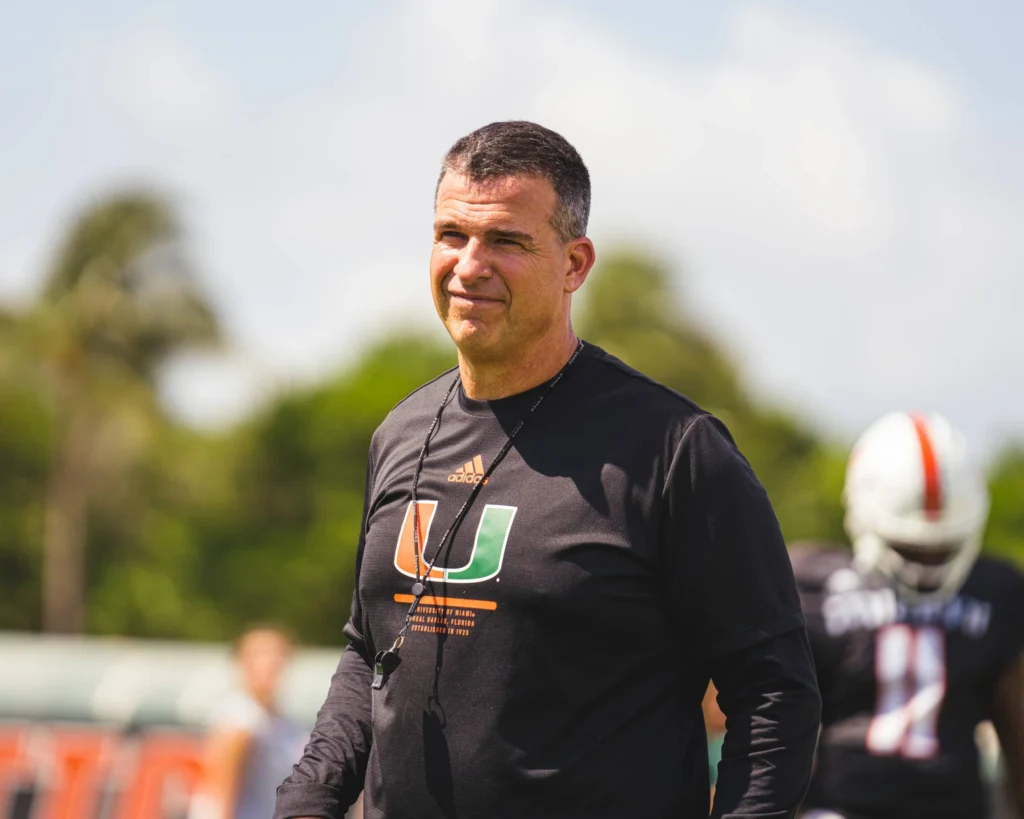
That was a heck of a statement for fourth-year Hurricanes coach Mario Cristobal and his team, which got an inspired performance from its extremely talented offensive line and veteran running back Mark Fletcher Jr. to go with its typically dominant performance on defense, where the Canes have ranked among the best in the nation all season.
Hypothetically, of course, a 10-2 ACC team would never beat an 11-1 SEC team, especially on the SEC team’s home field — insert your favorite sarcasm punch line here — so everyone should be glad that fans actually got to see those teams play each other, rather than having a committee or the countless SEC sycophants suggest that this particular ACC team didn’t belong.
Now the Hurricanes (a nine-point underdog) will have to try to take another step up in weight class, because Ohio State not only has a brilliant defense (as A&M did), the Buckeyes also have a consistently prolific offense (A&M did not). For Miami to have a chance in this one, two things will have to happen.
First, the Hurricanes’ defensive front — led by ends Rueben Bain Jr. and Akheem Mesidor — will have to defeat Ohio State’s offensive line at the point of attack; when Indiana did that in the Big Ten championship game, it was one of the keys to the Hoosiers’ narrow 13-10 victory over the Buckeyes.
Second, Miami’s sixth-year senior quarterback, Carson Beck, will have to play at least as well as Ohio State’s star sophomore signal-caller, Julian Sayin, who earned second-team All-Big Ten honors behind only Indiana’s Heisman Trophy winner, Fernando Mendoza.
Neither Beck nor Sayin is much of a running threat, but Sayin has done a better job this season of limiting his mistakes and getting the ball to his top wide receivers, first-team All-Big Ten selections Jeremiah Smith and Carnell Tate, than Beck has done with a receiving corps that desperately needs someone to step up in support of the Hurricanes’ superstar true freshman, first-team All-ACC wide receiver and dynamic return specialist Malachi Toney.

CFP Quarterfinals: Game Two
#4 Texas Tech (12-1) vs. #5 Oregon (12-1), Jan. 1, noon (ESPN)
Among the Power Four conferences, there is only one that hasn’t had any of its programs capture the national championship over the past 20 years.
That league is the Big 12, whose most recent crown came in 2005, when coach Mack Brown and quarterback Vince Young led Texas to the mountaintop, back before the Longhorns jumped to the SEC.
Remember, Michigan and Ohio State just went back-to-back over these past two seasons for the Big Ten, after that league had been absent from the national title talk for almost a decade. In the ACC, Clemson has two national championships under coach Dabo Swinney, both within the past decade, and Florida State won it all under coach Jimbo Fisher in 2013.
Obviously, the SEC has been at the top of this particular list for decades, including national titles for five different schools — Alabama, Auburn, Florida, Georgia and LSU — just since the turn of the century.
Now the 2025 Big 12 champion, the 12-1 Texas Tech Red Raiders, who are already in the midst of the greatest season in program history, get a chance to carry their conference flag, albeit against an extremely difficult quarterfinal opponent in 12-1 Oregon.
Texas Tech is perhaps the greatest example of having a very aggressive financial plan in anticipation of this season — the first in NCAA history, remember, that allows universities to pay their athletes directly and still allows for additional Name-Image-Likeness money from third parties — and the Red Raiders have been rewarded handsomely for their approach, with all 12 of their victories this season by dominant margins.
The Red Raiders are led by a transfer-bolstered defense that ranks as one of the best nationally. All-American linebackers Jacob Rodriguez and David Bailey are transfers from Virginia and Stanford, respectively. All-American tackles Lee Hunter and AJ Holmes Jr are transfers from UCF and Houston, respectively. All-Big 12 linebacker Romello Height and All-Big 12 cornerback Brice Pollock are transfers from Georgia Tech and Mississippi State, respectively.
Despite all of that, Oregon is the very slight (one-point) favorite in this game, for two main reasons.
First, under fourth-year coach Dan Lanning, the Ducks are a combined 25-2 over the past two seasons, with their only losses to 2024 Ohio State (which won the national championship) and 2025 Indiana (which is 13-0 and the #1 seed in this year’s playoff).
That’s just an absolutely stunning record, and the Ducks are really well-coached, really good on both sides of the ball, and they’ve played in a bunch of huge games during their first two seasons as members of the Big Ten.
Second, if there are fair questions about Texas Tech, one is how the Red Raiders will respond against an opponent that’s definitely better than any of their Big 12 foes. Another is whether their offense — led by fifth-year senior QB Behren Morton, a three-year starter — can keep up with the Ducks’ attack, led by a big-time NFL prospect in quarterback Dante Moore.
In the final analysis, nobody should be surprised if this is a relatively low-scoring affair that ultimately comes down to big plays and turnovers.

CFP Quarterfinals: Game Three
#1 Indiana (13-0) vs. #9 Alabama (11-3), Jan. 1, 4 p.m. (ESPN)
It’s not an exaggeration to describe Indiana football’s ongoing rise under second-year head coach Curt Cignetti as one of the greatest turnarounds in college football history.
In the Hoosiers’ first 100-plus seasons as a program, they finished in the national top 10 only twice, way back in 1945 and 1967. Now, despite taking over a program that had posted only one top-25 campaign in the 35 years before his arrival in Bloomington, Cignetti is in the midst of back-to-back top-10 finishes and — at 13-0 and the #1 playoff seed this year — he has a legitimate chance at IU’s first national championship on the gridiron.
Anyone who laughs at that possibility probably also laughed at the idea that the Hoosiers would ever claim another Big Ten football title. Well, they just did, under Cignetti, beating mighty Ohio State 13-10 earlier this month for that long-awaited crown.
In the Bold North State, Duke just claimed its first ACC football title since 1989 and its first outright title since 1962. Guess what? Indiana’s waits were even longer. The Hoosiers hadn’t won the Big Ten championship since 1967, and they hadn’t won it outright since 1945.
How would the college football world react if the Blue Devils were 13-0 and the #1 playoff seed? That’s exactly what Indiana is doing, right now, and it’s almost impossible to believe … at least until you watch the Hoosiers play.
By now, everyone knows the story of Indiana quarterback Fernando Mendoza, the Cal Bears transfer who just claimed the Heisman Trophy and the Big Ten Player of the Year honor, during his first season with the Hoosiers.
What may be less obvious is that, as they showed in the Big Ten title game, the Hoosiers’ relentless defense may be just slightly more impressive than their explosive offense.
Defensive tackle Tyrique Tucker, one of the many players Cignetti brought with him from James Madison, was a first-team All-Big Ten selection. Aiden Fisher and D’Angelo Ponds, two more JMU transfers, have received All-American recognition at linebacker and cornerback, respectively.
Alabama’s defense, which has been outstanding all season, may have a chance to slow down the Hoosiers’ offense, as Iowa, Penn State and Ohio State managed to do earlier this season.
The bigger question for the Crimson Tide (a seven-point underdog) in this one may be whether star quarterback Ty Simpson, a highly regarded NFL prospect, will get enough help from his friends against that elite Indiana defense.
Alabama has additional NFL prospects on the offensive line and at wide receiver, but the Tide’s running game has struggled all season, and the offense’s occasional inefficiency ultimately proved to be the team’s undoing in its losses to Florida State, Oklahoma and Georgia earlier this season.
CFP Quarterfinals: Game Four
#3 Georgia (12-1) vs. #6 Ole Miss (12-1), Jan. 1, 8 p.m. (ESPN)
This Georgia-Ole Miss contest is this week’s only rematch from the regular season, and Game One between the Bulldogs and the Rebels was an absolutely wild affair, with these teams’ offenses taking turns just tearing up the opposing defenses.
Ole Miss actually scored touchdowns on each of its first five possessions in front of a stunned crowd in Athens back in mid-October, with each TD drive gobbling up 65 yards or more, and the Rebels led 35-26 midway through the third quarter. The Rebels ultimately stalled out and fell by a 43-35 margin, after the Bulldogs tallied three touchdowns and a field goal on their four full possessions of the second half.
Overall, Georgia has limited 11 of its 13 opponents to 24 points or fewer this season, but there clearly was something about coach Lane Kiffin’s offense — led by second-team All-SEC quarterback Trinidad Chambliss, a Division Two transfer — that drove the Dawgs crazy.
Kiffin has departed for LSU, of course, but Ole Miss offensive coordinator Charlie Weis Jr — who also is headed to LSU — was allowed to stay behind for the Rebels’ playoff run. Weis (not Kiffin) has called the plays for the Rebels in recent years, and his offense continued to look brilliant in the team’s 41-10 victory over Tulane last week in the CFP’s first round.
Even if Ole Miss (a six-point underdog) somehow continues its offensive mastery of Georgia, though, it’s logical to ask how the Rebels are going to slow down the Bulldogs’ offense.
Quarterback Gunner Stockton just led Georgia to the SEC title in his first year as the team’s full-time starter, and while the Dawgs’ running game hasn’t been quite as strong as in the past, Stockton has an NFL-caliber wide receiver at his disposal in Southern Cal transfer Zachariah Branch and a quality tight end in Lawson Luckie, who had three touchdown catches against Ole Miss in that regular-season contest.
The Dawgs also have one of the nation’s top special teams units, with All-SEC standouts in Branch as a return man, plus kicker Peyton Woodring and punter Brett Thorson.