COLLEGE FOOTBALL WEEK FIVE:
Joe Montana, UNC, Duke, Wake, Elon, D2
Among DG’s ACC/NC “Fun Facts & Shout-Outs”
By David Glenn
North Carolina Sports Network
(last updated Sept. 30, 2026)
While the focus of our weekly college football shows are forward-looking as often as possible, we always take a glance back at the previous week, too, and sometimes we’ll offer some quick mentions to those making impactful headlines on the gridiron, especially in the Atlantic Coast Conference and/or across North Carolina.
With that in mind, below are our Week Five “Fun Facts and Shout-Outs,” brought to you by our good friends at Jimmy’s bar and King Neptune restaurant in Wrightsville Beach and the same folks’ latest creation, Jimmy’s Inland, their new bar in Wilmington.
Jimmy’s has a full bar, nightly drink specials and live music 365 days a year(!). (It’s a great place to watch a game, too.) Right next door in Wrightsville Beach, King Neptune has become one of the best restaurants in the greater Wilmington area. Jimmy’s Inland, which features live music, pool tables, darts, an arcade and the brand’s signature slushies, is located about a mile from the UNC Wilmington campus.
Week Five “Fun Fact #1”
Fun Fact: One of the biggest stars in football history first entered the national spotlight as a visiting backup player right here on North Carolina soil.
Joe Montana is best-known these days as the four-time Super Bowl champion quarterback of the San Francisco 49ers. He also was an eight-time Pro Bowler, a five-time All-Pro honoree, a three-time Super Bowl most valuable player, and a two-time National Football League MVP.
In 1975, though, Montana was merely Notre Dame’s backup quarterback as the Fighting Irish visited UNC in mid-October, just as the Irish once again are visiting the Tar Heels this Saturday. About 51 years ago, Montana stood on the Kenan Stadium sidelines as an unused reserve for more than three quarters, as UNC — then coached by Bill Dooley — took a 14-0 lead into the fourth quarter.
The rest, as they say, is history.
With the Irish still trailing 14-6 midway through the fourth quarter, Montana entered the game in emergency mode and quickly engineered a 73-yard touchdown drive, then immediately added a two-point conversion to tie the game. On his next possession, after Carolina missed a field goal attempt, Montana took over at the Irish 20-yard line with 1:19 remaining on the clock. On second down, Montana tossed an 80-yard touchdown pass, and the Irish went on to win the game 21-14.
Montana’s actual presence on the field against UNC, as measured by game-clock time, lasted for barely more than a minute. Yet he engineered 15 of Notre Dame’s 21 points and led the Irish to victory.
Two years later, after sitting out the 1976 season with an injury, Montana led Notre Dame to the 1977 national championship. In 1978, he was off to the NFL.
And those sensational seeds planted 51 years ago at Kenan Stadium in Chapel Hill? They represent, quite nicely, The Rest Of The Story.
Now on to this week’s shout-outs, brought to you by our friends at Muscle Milk, as we head into Week Five …

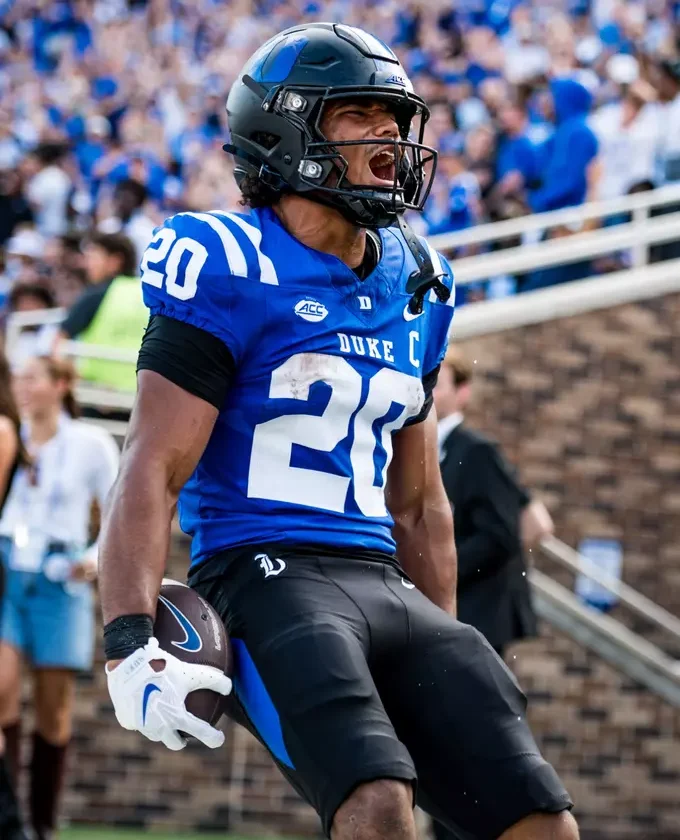
#1—Shout-out to Duke sophomore running back Nate Sheppard.
Entering Week Five, Sheppard (pictured above) leads the nation in both rushing yards per game (161) and all-purpose yards per game (178), and he’s by far the #1 reason the Blue Devils are off to their sizzling 4-0 start.
College football fans and NFL scouts continue to learn more about Sheppard’s story, as he remains firmly in the national spotlight.
Both of his parents were athletes at Louisiana Tech. His brother Will, who was a star wide receiver at Vanderbilt and Colorado during his college career, has spent time with the Green Bay Packers and the Miami Dolphins in the NFL over the past two seasons.
Sheppard was a Freshman All-American and a second-team All-ACC honoree last year, when he rushed 200 times for 1,132 yards and 11 touchdowns for the ACC champion Blue Devils, and now the 5-foot-10, 205-pounder is clearly an even better player this year.
In the Blue Devils’ season-opening victory over Tulane, on an afternoon when the Duke passing attack was erratic and the Duke defense was breaking in an entirely new line, Sheppard saved the day with 35 carries for 227 yards and the only two touchdowns of a 17-3 game. As a result of Sheppard’s heroics, Duke’s mostly new defense was on the field for only 23 minutes against the Green Wave.
Those 227 rushing yards in that early September contest, by the way, still rank as the best 2026 single-game running performance by any FBS player four weeks later, and that number also represents the fifth-highest total in Duke history.
Since then, Sheppard has posted three more games of 100-plus rushing yards, and in Duke’s 31-27 victory at Illinois, he showcased his receiving skills, too, catching five balls for 41 yards and two touchdowns. He is averaging more than seven yards per carry, and he’s doing so with an awesome combination of power, relentless effort and you-have-to-see-it-to-understand-it slipperiness that makes him very hard to tackle.
Although there’s still a long way to go this season, and Duke still must face some very tough defenses, including Miami’s on Nov. 14, Sheppard appears to have a legitimate chance to join the very exclusive club of year-by-year rushing leaders in the FBS ranks.
That list includes legends such as Southern Cal’s OJ Simpson and Marcus Allen, Ohio State’s Archie Griffin, Pittsburgh’s Tony Dorsett, Texas’ Earl Campbell and Ricky Williams, South Carolina’s George Rogers, Oklahoma State’s Barry Sanders, San Diego State’s Marshall Faulk, TCU’s LaDainian Tomlinson and Alabama’s Derrick Henry, many of whom went on to amazing success in the NFL, too.
The only ACC players ever to lead the FBS ranks in rushing — at least for now — were Wake Forest legend Brian Piccolo in 1964, UNC legend Don McCauley in 1970, and Boston College star Andre Williams in 2013.

#2—Shout-out to second-year Wake Forest head coach Jake Dickert, his second-year offensive coordinator Rob Ezell, their new starting quarterback Gio Lopez and their veteran wide receiver Carlos Hernandez.
About three days before the Demon Deacons’ challenging matchup at nationally ranked Louisville last week, there were no obvious, massive depth chart advantages for either side. The Deacons and the Cardinals each carried a 2-1 record into that contest, with both losses (Miami for Wake, Ole Miss for Louisville) coming to opponents ranked in the national top 10.
Two days before the game, however, Louisville announced that one of its defensive stars, linebacker/safety hybrid Antonio Watts, would miss the remainder of the season because of a knee injury suffered in practice. Meanwhile, Keon Entringer, another Louisville starter at safety, initially was listed as “probable” on the Cardinals’ injury report, then “questionable” and then — on game day — Entringer was listed as unavailable with an undisclosed injury.
Suddenly, Wake Forest had a potentially weak link to attack in the Louisville secondary, and in the end — to the eternal credit of Dickert, Ezell, Lopez and Hernandez — the Demon Deacons’ game-plan tweaks and intelligent execution clearly proved to be the difference in a very close game the Deacons ultimately captured by just a 30-27 margin.
Ezell called a bunch of pre-snap motion plays that forced Louisville’s defensive backs to make split-second communication decisions on Lopez’s downfield throws, and Lopez seemed to take advantage every time those communications went awry, most obviously on a 77-yard touchdown toss to a wide-open Hernandez in the second quarter. On that play, spectators and TV viewers could actually see one of the Louisville d-backs wildly gesturing in an attempt to alert a clueless teammate about a late assignment switch, to no avail.
Lopez finished the game a highly efficient 12-for-19 in the passing game for 225 yards.
Meanwhile, Hernandez — who now ranks fifth nationally with 129 receiving yards per game — nearly became just the third Wake player ever to achieve 200 or more receiving yards in a single game. He finished with nine receptions for 194 yards, including that TD catch, which proved to be the biggest play of the game and probably the ultimate difference in the game.
That, friends, is exactly the way great coaching and play-calling, in concert with veteran players’ high football IQs and smooth execution, can be the difference between winning and losing a gridiron contest between two otherwise evenly matched teams.

#3—Shout-out, at the Football Championship Subdivision (FCS) level, to eighth-year Elon head coach Tony Trisciani and the 4-1 Phoenix.
As Elon’s former defensive coordinator, Trisciani worked under Curt Cignetti — yes, the guy who led Indiana to a national championship, in the sport of football, just last year — on some high-quality Phoenix teams in 2017 and 2018. Both of those squads made the FCS playoffs and finished in the Top 25.
As Elon’s head coach, Trisciani’s best campaign thus far came when he led the Phoenix to an 8-4 record, the FCS playoffs and a Top 25 finish in 2022, and his teams have had records of .500 or better in conference play for five years in a row and counting.
Now Trisciani has the 2026 Phoenix off to an impressive 4-1 start while playing some of his trademark high-IQ, hard-hitting defense along the way. Entering Week Five, Elon leads the Coastal Athletic Association in scoring defense (15 points per game) and in total defense (259 yards per game).
Elon’s stars on defense have included redshirt junior middle linebacker Brodie Carroll, redshirt junior “bandit” Tony Hart III and graduate student end Dillon Pardue.
All three players are in their second year as starters under Trisciani. Hart (Dunbar High in Baltimore) and Pardue (Cleveland High in Clayton) signed with the Phoenix out of high school, while Carroll transferred into the program in 2025, after two years at Shepherd University, a Division Two program based in West Virginia.
The Phoenix haven’t won a conference championship in football since 1981, when they were an NAIA program.
If they can claim a victory at 1-4 New Hampshire this week to improve to 5-1 and 3-1 in CAA competition, a championship campaign under Trisciani would remain at least a possibility in a league that has lost Delaware to the FBS ranks and Richmond, Villanova and William & Mary to the Patriot League, another FCS conference, just within the past two years.
Last, but certainly not least…

#4—Shout-out, at the Division Two level, to second-year Mars Hill head coach Kevin Barnette and the 4-0 Lions.
Formerly the program’s long-time defensive coordinator, Barnette has Mars Hill playing the best defense in the entire D2 ranks, with a yield of only seven points per game, and — starting this week — the Lions also are ranked in the Top 25 of every major D2 poll.
Last September, Barnette — after almost four decades as an assistant coach at Mars Hill — posted his first victory as a head coach, and it came at home over a nationally ranked Carson-Newman squad. Last week, the Lions also captured the return match, this time on the road against a nationally ranked Carson-Newman team. The Lions won 10-6 this time, limiting the Eagles to just nine first downs, 178 yards of total offense and a pair of field goals.
Barnette, who’s already in the Mars Hill Athletics Hall of Fame because of his success as an All-American defensive back in the 1980s, had been the school’s defensive coordinator for 31 seasons prior to last summer, when he got promoted to head coach after the retirement of Tim Clifton, who had been the Lions’ leader for 32 years.
Now Barnette, through his 2026 team’s 4-0 start, is clearly getting the best out of a defensive group led by junior linebacker Jamarion Farrior and three products of the western North Carolina high school ranks.
Senior linebacker Isaac Weaver is from tiny Andrews High in Andrews, senior defensive tackle Russell Barnett is from Reynolds High near Asheville, and junior defensive back Caden Hilemon is from Madison High in Marshall, which is just a 15-minute drive from Mars Hill.
Barnette actually grew up in Mars Hill, a tiny town — population about 2,000 — in the mountains, just north of Asheville, so his entire success story seems to qualify quite nicely as both the proverbial Life-Long Dream Come True and The Local Guy Done Good.
Congratulations, Coach Barnette, on a job very well-done.