COLLEGE FOOTBALL WEEK SIX:
Power Four (70-3!), UNC, NCSU, Wake, WCU
Among DG’s ACC/NC “Fun Facts & Shout-Outs”
By David Glenn
North Carolina Sports Network
(last updated Oct. 5, 2026)
While the focus of our weekly college football shows are forward-looking as often as possible, we always take a glance back at the previous week, too, and sometimes we’ll offer some quick mentions to those making impactful headlines on the gridiron, especially in the Atlantic Coast Conference and/or across North Carolina.
With that in mind, below are our Week Six “Fun Facts and Shout-Outs,” brought to you by our good friends at Jimmy’s bar and King Neptune restaurant in Wrightsville Beach and the same folks’ latest creation, Jimmy’s Inland, their new bar in Wilmington.
Jimmy’s has a full bar, nightly drink specials and live music 365 days a year(!). (It’s a great place to watch a game, too.) Right next door in Wrightsville Beach, King Neptune has become one of the best restaurants in the greater Wilmington area. Jimmy’s Inland, which features live music, pool tables, darts, an arcade and the brand’s signature slushies, is located about a mile from the UNC Wilmington campus.
Week Six “Fun Fact #1”
Fun Fact: Entering Week Six of this year’s college football slate, Power Four teams had 70 victories and only three defeats against Group of Six opponents this season, continuing a massive shift in the dominance of Atlantic Coast Conference, Big Ten, Big 12 and Southeastern Conference programs over everyone else in this extremely money-driven era of NCAA revenue-sharing and Name-Image-Likeness (NIL) contracts.
Of course, this is a “Fun Fact” only if you’re a member of one of those top four leagues. For everyone else, it’s definitely been not-so-fun, especially this season.
For perspective on the size of that Power Four-over-Group of Six gap, consider that the record of Football Championship Subdivision (FCS) teams against Football Bowl Subdivision (FBS) opponents over the past season and a half has been 10-223 — 10 victories, 223 defeats. This number probably doesn’t surprise most college football fans, but that record translates to the fact that FBS teams have been beating FCS teams head-to-head about 96 percent of the time.
Now, because of a combination of the transfer portal, immediate transfer eligibility and those other (money-related) matters, Power Four programs are poaching the top players from Group of Six programs even more than they did previously, and those results are continuing to show up on the field.
Now this year’s 70-3 record for the Power Four against the Group of Six also translates to a roughly 96 percent success rate, meaning the gap between the Group of Six and the Power Four has grown so much that it’s now statistically similar to the always-enormous gap between the FCS and FBS ranks.
Here’s another illustration, just to pound the point home.
In the decade or so before all the huge rules changes, back when the Pac-12 was still considered a Power Five league, Group of Five teams — the American Conference, Conference USA, the Mid-American Conference, the Mountain West and the Sun Belt — beat Power Five opponents roughly 20 percent of the time when they played head-to-head. Now, in the immediate aftermath of the NCAA’s money-related and eligibility-related rules changes, that Group of Six success rate against the Power Four has dwindled to about four percent.
Remember, under the rules of the so-called House settlement, which was a result of a player-led lawsuit against the NCAA, the revenue-sharing “ceiling” for each participating school is almost $21.6 million during this ongoing 2026-27 academic year.
Virtually every Power Four program spends to that $21.6 internal limit, with a large majority of that money going to football players, and they’re able to supplement that $21.6 million with third-party NIL money. On the other hand, nobody in the Group of Six leagues is spending anywhere near the $21.6 million annual revenue-sharing limit, and the NIL money available to players in those six leagues — including those at App State, Charlotte and East Carolina here in the Bold North State — also pales in comparison to what many Power Four players now regularly get in the open market.
For anyone wondering, the only three examples — at least so far this season — of a Group of Six team beating a Power Four team came from UMass, Tulsa and UNLV. UMass, which is a member of the MAC now, beat Rutgers 37-21 in Week One. Tulsa, which is in the American Conference, beat Oklahoma State 24-10 in Week One. Most recently, UNLV, which is in the Mountain West, beat Cal 39-31 in Week Five. That’s it; that’s the entire list.
The 70 Group of Six defeats against the Power Four, of course, include App State’s 41-31 loss at NC State, ECU’s 48-10 loss at Alabama, and Charlotte’s 41-9 loss at Ole Miss.
If it feels or seems harder these days to spring those upsets over Power Four opponents, folks, that’s because — statistically speaking — it is harder than it was for most of our lifetimes. A lot harder.
Now on to this week’s shout-outs, brought to you by our friends at Muscle Milk, as we head into Week Six …

#1—Shout-out to Wake Forest offensive coordinator Rob Ezell and Demon Deacons quarterback Gio Lopez.
Most in our audience know by now that Ezell and Lopez also were together two years ago, at South Alabama. Back then, in 2024, Lopez ranked second in the Sun Belt Conference and within the top 25 nationally in total offense (275 yards per game), South Alabama finished second in the Sun Belt in scoring offense (34 points per game), and the Ezell-Lopez combination proved to be central to the Jaguars’ winning record and dominant bowl victory.
Ezell left South Alabama after that 2024 season to join Jake Dickert, who at that point was the brand-new head coach at Wake Forest, having left Washington State to take the job with the Demon Deacons. Lopez, of course, took a one-season detour to North Carolina and suffered through a very difficult 4-8 season with the Tar Heels in 2025 before making his move to Winston-Salem this past January.
Together again, Ezell and Lopez once again are doing some very special things, this time with the Demon Deacons.
Through Wake’s 4-1 start, the Deacons ranked sixth in the ACC in scoring offense (37 points per game), and Lopez ranked eighth in the nation in total offense (314 yards per game). Through Week Five, Lopez also was the only ACC quarterback who ranked among both the league’s passing leaders and its rushing leaders from the QB position.
Lopez’s 275 passing yards per game rank behind only SMU’s Kevin Jennings, Miami’s Darian Mensah, Virginia Tech’s Ethan Grunkemeyer and Louisville’s Lincoln Kienholz. Meanwhile, as a runner, the only ACC quarterbacks who have more than Lopez’s 193 rushing yards are Boston College’s Mason McKenzie and Florida State’s Ashton Daniels, who both have had only limited success as passers this season.
Another way to put it is that Lopez, in a conference with plenty of talent at quarterback, is the only signal-caller averaging more than 275 yards per game through the air and nearly 40 yards per game on the ground.
There are a lot of good reasons Wake Forest is off to that 4-1 start this season, but the Ezell-Lopez combination is at or near the top of the list.
#2—Shout-out to NC State edge rusher Harvey Dyson III.
A decorated transfer from Tulane, Dyson made one of the biggest plays of the Wolfpack’s season — and one of the most admirable and impressive plays by anyone in the entire ACC this year — in the fourth quarter of the Pack’s 31-28 home victory over Louisville last Saturday.
With the game tied at 28 and less than 10 minutes to play, Louisville executed a between-the-tackles running play to tailback Keyjuan Brown from its own 38-yard line. Brown, who has been leading the ACC with more than 10 yards per carry this season, darted through the NC State line with minimal contact and surged into the open and past the midfield logo at Carter-Finley Stadium, with the realistic possibility of a 62-yard touchdown run on his mind.
As an edge rusher, Dyson was outside the hashmarks and nowhere near the play when Brown ran up the middle. After being blocked toward the offensive backfield, behind the line of scrimmage, Dyson was at least six full yards behind Brown at one point, and Dyson had to completely reverse his momentum to chase Brown, who was running at full speed before encountering some potential NC State tacklers farther downfield.
On a play that he easily could have given up on, Dyson never stopped pursuing Brown, who had to pivot a couple times downfield to avoid State’s defensive backs. Meanwhile, the 6-foot-2, 257-pound Dyson finally caught up to Brown at the end of a full-scale, 45-yard sprint.
Just as Dyson — still running near full-speed — neared Brown at around the 20-yard line, Dyson used his left arm to grab, twist and strip the ball from Brown’s grasp while tackling him. NC State linebacker Popo Aguirre, also in desperate pursuit after a long sprint, then fell on the fumble at the Wolfpack’s 13-yard line for the absolutely enormous, game-changing turnover.
NC State drove down the field and kicked a field goal on the ensuing possession, and the Wolfpack ultimately held on for the 31-28 victory. That gave the Pack a much prettier 3-2 record instead of an incredibly ugly 2-3 mark on the season, and Dyson’s gargantuan, high-effort play made all the difference.
A fifth-year senior from Cedar Hill, Texas, Dyson signed with Texas Tech out of high school but played little during his three years with the Red Raiders. He had his break-out season in 2025, at Tulane, when he posted eight sacks and earned third-team All-American Conference honors.
Now Dyson has his break-out game and his break-out play for the Wolfpack, and as a direct result, the Pack can still harbor hopes of a special 2026 season.

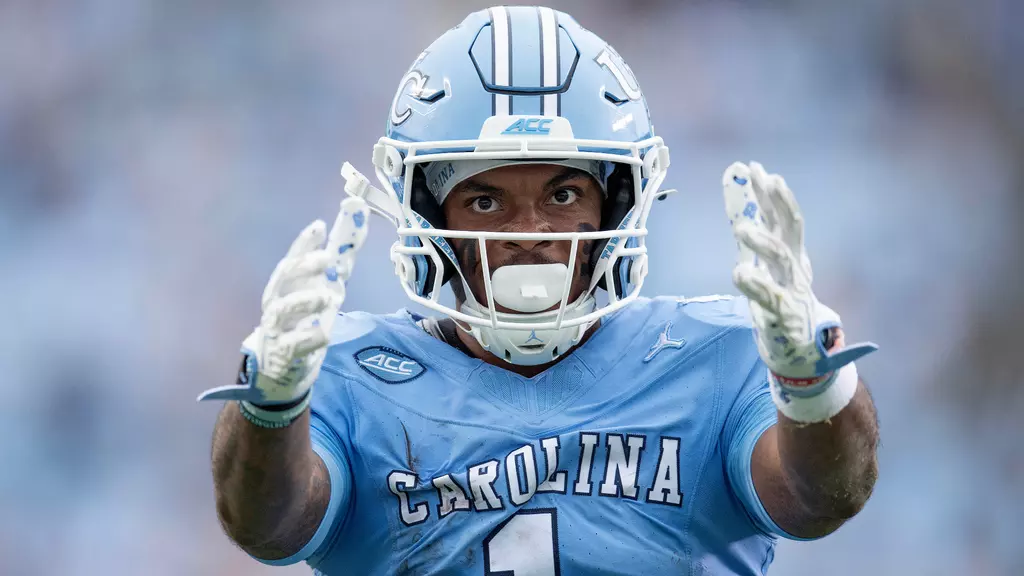
#3—Shout-out to North Carolina wide receiver Jordan Shipp.
A junior from Providence Day School in Charlotte, Shipp may be the best player at any in-state college program this year who is a product of North Carolina’s high school ranks.
An honorable mention All-ACC selection last year as a sophomore with the Tar Heels, Shipp now already has his diploma from UNC, he’s one of the Heels’ team captains, and he ranks among the conference’s top 10 players in receiving yards while playing on a squad with a somewhat limited passing attack.
Despite being matched against NFL cornerback prospects such as TCU’s Vernon Glover Jr., Clemson’s Ashton Hampton and most recently Notre Dame’s Leonard Moore, Shipp averaged six receptions for 83 receiving yards per game against those Power Four opponents, while often personally matched against those top-notch future pros. Hampton and Moore both are projected as first-round NFL picks.
Shipp projects as an NFL player, too, especially after his strong head-to-head performances against such high-caliber competition.
Shipp also stands out as perhaps the top in-state player on any in-state college football roster.
The most outstanding player at Duke, running back Nate Sheppard, is from the Louisiana high school football ranks. Two top standouts at NC State, quarterback CJ Bailey and cornerback Brian Nelson II, are from Florida and Texas, respectively. The most elite performers at Wake Forest, quarterback Gio Lopez, wide receiver Carlos Hernandez, defensive end Langston Hardy and safety Davaughn Patterson, are from Alabama, California, Florida and Florida, respectively.
A 6-foot-2, 200-pound wideout with an intense competitive streak, Shipp is one of the Tar Heels’ best players … and a North Carolinian through and through.
Before signing with Mack Brown and remaining in Chapel Hill through UNC’s coaching transition to Bill Belichick, Shipp was a three-time state champion, a three-time all-state performer and — in his final prep season — one of the state’s top 10 high school seniors.
Now Shipp just might be the #1 North Carolina product in the state’s college football ranks, too.
Last, but certainly not least…

#4—Shout-out, at the FCS level, to sixth-year Western Carolina coach Kerwin Bell.
It’s not easy to win in football at Western Carolina, but Bell has been doing quite a bit of it, often with a flair for the spectacular. That actually has been among his trademarks dating all the way back to his playing days in the 1980s.
Although the Western Carolina football program has been around for nearly 100 years at this point, it has never had five winning seasons in a row. Bell has a very good chance of ending that narrative this season, after posting winning records in each of his past four campaigns with the Catamounts and putting together another very dangerous squad here in 2026.
Last Saturday night in Cullowhee, which is about 50 miles southwest of Asheville, Western hosted a top-10 team in the FCS polls. Tennessee Tech came to town with a very high-scoring offense, an unblemished 4-0 record and the #8 national ranking. Tennessee Tech then left town with its first loss of the season, a 44-20 slaughter at the hands of the Catamounts.
Bell is no stranger to big headlines.
After beginning his college career with the Florida Gators as a walk-on in the mid-1980s, Bell eventually became not only a scholarship player but the Gators’ starting quarterback. In 1984, Bell won the SEC player of the year honor while leading the Gators to a 9-1-1 record, the SEC championship and a top-five postseason national ranking. He was a two-time All-SEC honoree, as a sophomore in 1984 and as a senior in 1986. He later played in the NFL and the Canadian Football League.
Decades later, as a coach, Bell led Valdosta State to the Division Two national championship in 2018, when the Blazers went 14-0 and led the nation in scoring, at 52 points per game.
Three years ago, Bell led Western Carolina into the national top 10 of the FCS polls, one of the high-water marks in program history, before finishing with a 7-4 record and the program’s first postseason Top 25 ranking since 1984. In the past two seasons, the Catamounts — who have never won the Southern Conference football championship, despite 50 years of membership in that league — posted back-to-back second-place finishes in the SoCon standings.
Bell actually has Western Carolina back in the spotlight once again this week, with his team visiting #18 Mercer on Saturday afternoon. The Catamounts will be an underdog in that one, too, but regardless of what happens on that road trip, they’ll remain well-positioned to continue what might be the best five-year run in program history.
Congratulations, Coach Bell and the Catamounts, on another job well-done.