Without Injured Superstar Wilson
By David Glenn
North Carolina Sports Network
(last updated Feb. 16, 2026)
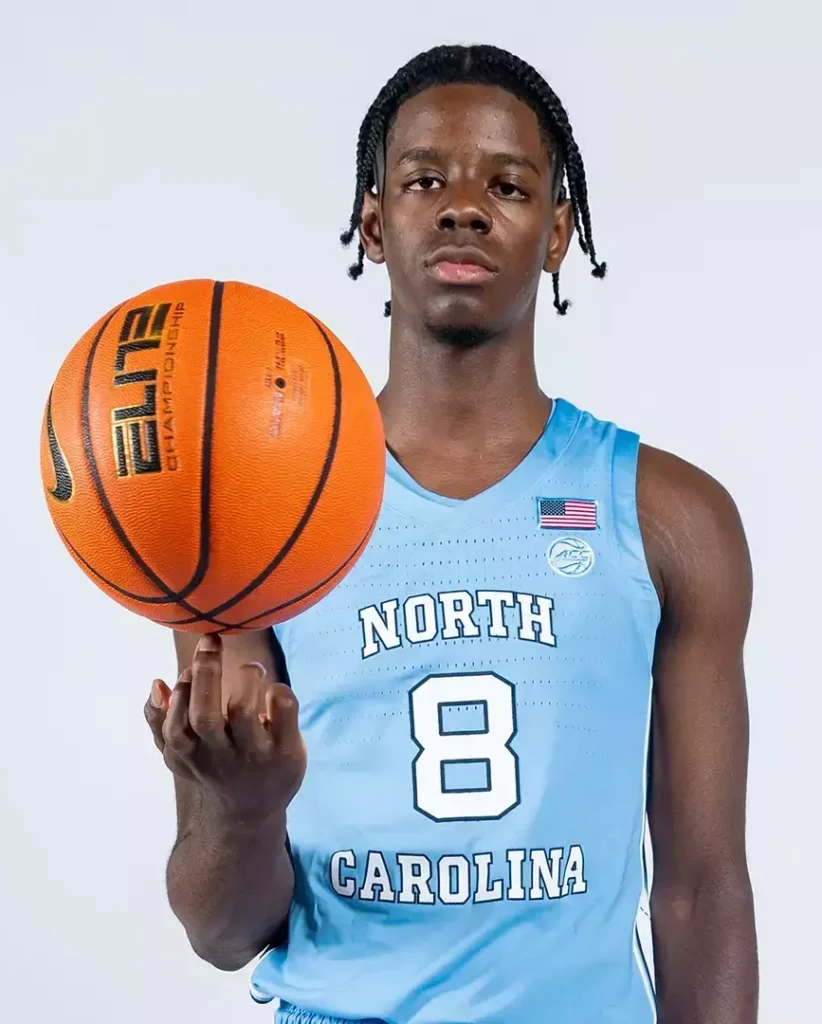
The most direct way to describe the impact of Caleb Wilson’s injury is to state, just as a statistical fact, that North Carolina has been an average basketball team without him during conference play this season.
The evidence for that statement comes with the reality that, during Atlantic Coast Conference competition, the Tar Heels have been one of the best teams in the league when Wilson is on the floor, but they have been the definition of mediocre when Wilson is not on the floor.
Here’s the data, through UNC’s 7-4 start in ACC play this season: During the 78 total minutes Wilson was getting a breather on the bench, the Heels outscored their opponents by a grand total of only two points.
In addition, just to provide one non-conference example of Wilson’s extraordinary impact, during UNC’s 87-74 victory over Kansas at the Smith Center way back in November, the Tar Heels outscored the Jayhawks by a whopping 21 points when Wilson was in the game. During those stretches when Wilson was on the bench, KU outscored Carolina by eight points.
Yes, he’s that much of a difference-maker — someone capable of a 29-point personal swing against a top-10 opponent. He’s also a virtual lock for first-team All-ACC honors and consensus All-America accolades, even if he misses a half-dozen regular-season games.
Amazingly, if Wilson can sustain (in one case) or slightly improve (in the other case) his sensational averages of 19.8 points and 9.4 rebounds per game, he even will finish above the Tar Heels’ current freshman record-holders in those categories — Tyler Hansbrough (18.9 ppg in 2006) and Antawn Jamison (9.6 rpg in 1996), who authored two of the other greatest rookie seasons in Carolina history.

If you’re wondering about other examples of key ACC players suffering significant injuries or other medical complications this season, that’s a mostly ugly picture, too, although there is one example of a top-tier team persevering through a major disruption to its rotation.
At Pitt, before the season even started, the Panthers lost their projected starting center, 6-foot-11, 270-pound Iowa State transfer Dishon Jackson, because of complications related to a heart condition.
With both Jackson and his projected backup, 6-10, 235-pound Papa Amadou Kante (knee surgery), on the sidelines, coach Jeff Capel‘s rotation regularly includes only one player taller than 6-6. As a result, the Panthers have the worst defensive stats in ACC play this season, and they’re tied for last in the league standings.
At Georgia Tech, there was understandably a lot of excitement about freshman center Mouhamed Sylla, one of the most prominent signees of the three-year Damon Stoudamire era on The Flats.
With Sylla in the lineup, the Yellow Jackets started the season with a solid 9-4 record. With Sylla sidelined by an ankle injury, they are 2-11 in conference play. Under the league’s new rules, that means they also are in serious jeopardy of missing the ACC Tournament, which now excludes the bottom three teams in the conference standings.
At Notre Dame, All-ACC guard Markus Burton was expected to be the centerpiece of a group that projected to be coach Micah Shrewsberry’s best during his three seasons with the Fighting Irish.
Instead, Burton broke his left ankle in early December, underwent surgery soon thereafter and hasn’t played since. Without him, instead of competing for an NCAA Tournament bid, the Irish (3-10) also could finish in the bottom three of the ACC standings.

At Syracuse, there were high hopes in the preseason that coach Adrian Autry would have the best team of his three-year head coaching tenure with the Orange.
Unfortunately, his best player, sophomore forward Donnie Freeman, suffered a right foot injury in mid-November. With Freeman, the Orange had started 4-0. Without him, they went just 5-4 against the remainder of their non-conference schedule. Freeman did return from his injury for the ACC schedule, and Syracuse (6-7) is right in the middle of the league standings, but the Orange’s 15-11 overall record leaves them well outside the NCAA Tournament conversation at this point.
Most recently, at Stanford, coach Kyle Smith and the Cardinal began the season 13-4 with senior forward Chisom Okpara in the lineup.
Then Okpara suffered a major knee injury (torn patellar tendon), needed surgery and is out for the remainder of the season. Without him, Stanford has lost six of its last eight ACC games and fallen completely out of the NCAA Tournament picture.

For additional ACC examples this season, consider Louisville with and without star freshman point guard Mikel Brown Jr. (back), or Virginia Tech with and without star forward Tobi Lawal (lower leg).
Both of those guys are back from their extended injury absences now, and the Cardinals and Hokies both look like NCAA Tournament squads when they are at their best. But their teams often struggled without them, and even after their returns, it took a while for them to find their grooves and rebuild their chemistry with their teammates.
Like #24 Louisville (19-6, 8-4 ACC) and Virginia Tech (17-9, 6-7), and unlike those other ACC examples, UNC still has a chance to make something of its season.
However, the #11 Tar Heels (20-5, 8-4) have a very difficult schedule (at NC State, at Syracuse, Louisville, Virginia Tech, Clemson, at Duke) to close the regular season, and with an uncertain timetable for Wilson’s return, this is likely to be a very scary stretch for Carolina and its fans.
“It really sucks, but we’ve been through this before,” said UNC senior guard Seth Trimble, who missed nine games earlier this season with a forearm injury. “These guys went through it when I got hurt. So we knew that it’s not time just to be sad and sob. We know we gotta push through and try to find light.”