Strategic Move Or Structural Overreach?
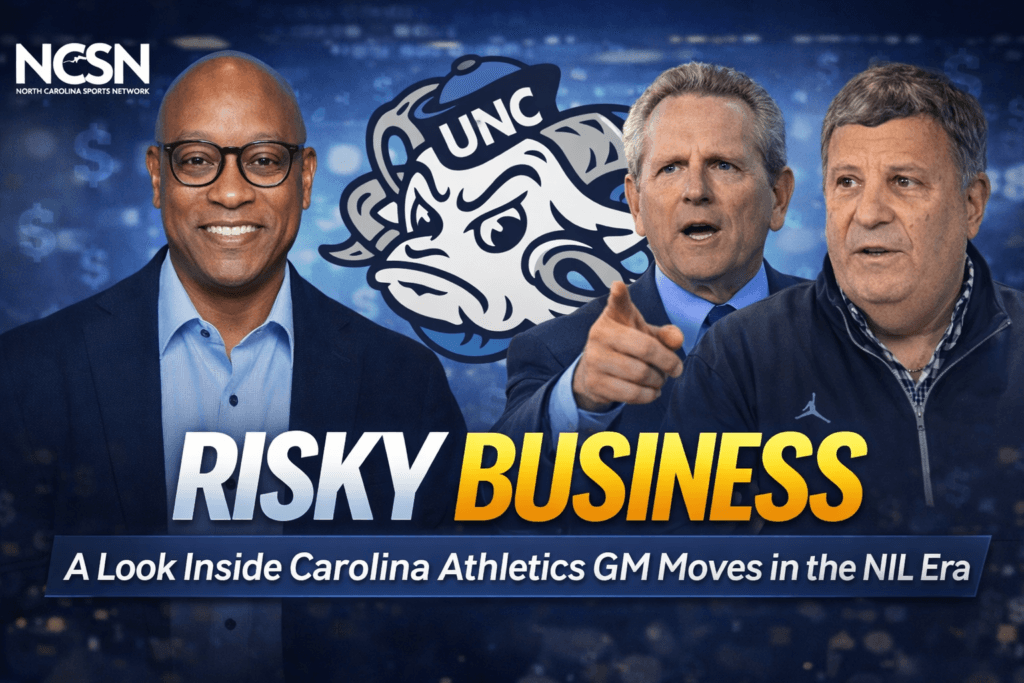
By Mike Waddell
North Carolina Sports Network
(last updated March 6, 2026)
After years of cautiously exploring the general manager model, the University of North Carolina at Chapel Hill is no longer treating the role as an experiment. In the Name-Image-Likeness (NIL) and transfer portal era, the GM has become a defining pillar of Carolina athletics’ evolving power structure.
College sports has changed. NIL money moves quickly. The transfer portal reshapes rosters seemingly overnight. Revenue sharing is no longer theoretical. The traditional structure — head coach, assistants and a lean support staff — no longer matches the financial machinery driving modern competition.
But adaptation and expansion are not the same thing.
UNC is not merely responding to change. It is reorganizing around it.

Patrick Suddes was the first general manager in a major UNC sport, working under Mack Brown in football before shifting into his current role as athletic department general manager. He earns $219,771 and now oversees revenue-sharing coordination while working directly with sport-specific GMs.
What began as a single-sport experiment has become institutional design. Suddes was once unique in Chapel Hill. He no longer is.
General managers now operate in football, men’s basketball, women’s basketball, baseball and women’s soccer — across both revenue-driving programs and sports that traditionally operate at a deficit. The GM model is no longer confined to one flagship team. It spans the department.
The title that once signaled innovation now signals infrastructure.
And infrastructure rarely contracts.

The Smith Center Salary Divide
Nowhere is the shift more visible than inside the Smith Center.
Jim Tanner, hired as UNC’s first men’s basketball general manager, earns $950,000 annually after triggering a contractual raise. His compensation places him firmly in executive territory — second only to head coach Hubert Davis within the program.
That fact signals more than a staffing adjustment. It signals a reordering of value.
Placed alongside the rest of the basketball payroll, the contrast is unmistakable:
Hubert Davis, head coach — $3,500,000
Jim Tanner, general manager — $950,000
Jeff Lebo, assistant coach — $427,146
Pat Sullivan, assistant coach — $390,143
Brad Frederick, assistant coach — $365,316
Sean May, assistant coach — $344,659
Eric Hoots, director of operations — $171,112
Marcus Paige, assistant coach — $104,000
Davis remains the program’s financial anchor.
But the second-highest paid figure in the operation is not an assistant coach. It is the general manager.
Tanner earns more than double any assistant, more than five times the director of operations and more than nine times Paige’s salary. The assistants handle player development, scouting, recruiting relationships and in-game adjustments. The GM oversees roster architecture, contract structuring and NIL coordination.
UNC has made a clear calculation: In modern college basketball, roster economics command executive compensation.
Regionally, annual compensation packages for comparable ACC basketball GM roles have been widely reported at around $400,000. UNC operates at more than double that figure.
This is not incremental modernization. It is a premium wager.

The Lombardi Benchmark
Football magnifies the pattern.
Michael Lombardi’s compensation has been widely reported at approximately $1.51 million annually, the highest publicly disclosed football GM salary in the country.
Not among the highest. The highest disclosed figure.
Regional peers operate at a fraction of that number:
Virginia — roughly $480,000
Clemson — roughly $390,000
NC State — roughly $375,000
South Carolina — roughly $250,000
Virginia Tech — roughly $200,000
Tennessee — roughly $150,000
UNC is paying between three and ten times what nearby public programs pay for comparable roles.
That is not market alignment. It is market leadership — in cost.
The argument is that pairing Lombardi with head coach Bill Belichick builds a professional infrastructure designed for sustained competitive advantage. Perhaps it does.
But once you set the top publicly reported number in the country, you assume a different burden.
You assume the burden of proof.

Same Title, Different Realities
Across the department, the GM label now spans multiple compensation tiers:
Michael Lombardi, football GM — approximately $1.51 million
Jim Tanner, men’s basketball GM — $950,000
Patrick Suddes, athletics-wide GM — $219,771
Chris Ducar, women’s soccer assistant coach and GM — $111,384
Liz Roberts, women’s basketball GM and special assistant — $91,339
Carter Hicks, baseball GM — $80,340
The title is uniform.
The authority, scope and compensation are not.
In some programs, the GM functions as a roster architect and contract strategist. In others, the role centers on NIL coordination and operations. In still others, it is layered onto existing coaching responsibilities.
UNC has standardized the label General Manager faster than it has standardized the job itself.
That is not inherently flawed, but it is structural expansion. And it exists alongside a department already populated by associate ADs, assistant ADs and deputy ADs.
Every hire can be justified individually.
Taken together, the pattern is clear: The executive tier is widening.

From Chiefs Of Staff To General Managers
The GM era did not emerge from nothing.
Just a few years ago, the indispensable title in major college athletics was Chief of Staff. Departments invested heavily in those positions to manage growing complexity. Chiefs of Staff centralized communication, coordinated strategy and stabilized leadership workflows.
Now the GM title sits beside them.
In theory, the distinction is simple. Chiefs of Staff manage internal structure. GMs manage roster economics and competitive architecture.
In practice, responsibilities often overlap.
At many institutions, NIL coordination, recruiting logistics and strategic planning were already handled by Chiefs of Staff, recruiting directors or operations executives.
The GM did not necessarily replace those roles. More often, it joined them.
Which raises a larger question: Are athletic departments becoming more efficient — or more layered?
Modernization requires new expertise.
It does not automatically require more titles.

A Department At An Inflection Point
UNC’s embrace of the GM structure is happening during a broader leadership shift.
The old college model, shaped by the 1980s, 1990s and early 2000s, centered on coaches and campus tradition. The emerging model looks more like professional sports — enterprise-driven, commercially structured and roster-economics focused.
The general manager framework fits naturally inside that environment.
If Carolina is deliberately pivoting toward a professional governance model, the salaries begin to look less like impulse and more like infrastructure.
But infrastructure carries expectation. Professional models demand professional accountability.

What Is Carolina Becoming?
This is not just about payroll.
It is about identity.
Tar Heel Nation is divided over the future of the basketball arena. Renovate or relocate. Preserve tradition or maximize revenue. Maintain broad-based athletics or hyper-focus on football and men’s basketball as financial engines.
Conference alignment hovers beneath the surface. Stay in the ACC out of history and loyalty, or explore the Big Ten or SEC in pursuit of long-term financial security.
These are philosophical questions.
A GM-heavy structure fits inside a professional sports framework.
But professionalization alters culture. It changes priorities. It shifts what fans expect and what institutions reward.
The real question is whether the culture, the fan base and the financial ecosystem of college athletics are ready for what that transformation actually means.

The Final Measure
There is a legitimate case for change. NIL, portal movement and revenue sharing demand new expertise.
But adaptation does not require expansion at every turn.
UNC has not cautiously piloted the GM model. It has institutionalized it.
In men’s basketball, the GM now sits above the assistant tier financially. In football, the GM salary leads publicly disclosed figures nationally. Across sports, the title spreads beneath a department-wide GM coordinating them all.
This is structural reinvention.
Maybe it works. Maybe Carolina gains a competitive edge that justifies every contract.
But institutions are judged by outcomes and by whether their structures become leaner or heavier over time.
UNC has chosen expansion.
If the wins follow, it will be called foresight.
If they do not, it will look like something else entirely: an athletic department that mistook growth for progress and built an executive class before proving it needed one.
Mike Waddell, co-founder of the North Carolina Sports Network, is a North Carolina native, a former Division One athletic director, and a long-time college and professional sports administrator.